See all my books!

Showing posts with label First Division. Show all posts

Thursday, October 3, 2013

18+ Days in A.E.F.'s footsteps: Day 9, St. Mihiel Battle and Montsec Memorial

     St. Mihiel is a little town along a peacefully flowing river in eastern France. South of Verdun, the town was vital to that city and to all points west for its control of train traffic. When the German Army attacked the town and held it in a tight grip in 1918, General Pershing decided to attack their fortifications and open communications and transportation before attacking the Germans in the Meuse River-Argonne Forest region to the north.
     In only 3 days, the Americans fought fiercely taking the ridges and the valley near St. Mihiel.
Today, the area consists of small villages and many farms.
American engineers march into St. Mihiel after taking the area within 3 days fierce fighting in September 1918.
The Montsec Memorial to those AEF forces who took this ridge and the towns below within 3 days is a beautiful tribute to the men who fought here. With a commanding view of the valley that they struggled to take, this Memorial offers a panoramic view—and inspires you to marvel at the feat these men accomplished.
In these few photographs, I attempt to show you a glimpse into their efforts–and their victory.
Montsec Memorial to AEF's 3 day battle of St. Mihiel
A closer view
A panorama into the valley near Thiacourt
Inside the rotunda sits a relief map of the valley that the AEF had to take from entrenched German Army.
Official description of the Battle of St. Mihiel at Montsec Memorial. Do enlarge to read.
Army Medical Corps cadeusus. Atop each pillar of Montsec is the insignia of a corps unit
contributing to the AEF's victory in this valley.
Atop Montsec, this floor map shows the villages AEF soldiers took in the 3 day offensive.
Dedication on steps up to top of Memorial.
To show the irony of both world wars, this plaque details how this land was once again a battleground.

Friday, August 16, 2013

18+Days in the AEF's footsteps: Day 8, Traveling through Champagne, East to the extended American front line and City of Verdun

 
Town Center of City of Verdun
This statue symbolizes the resistance
of the people of Verdun
to the German advances north of the town
in the Ring of Forts
     As the First Division arrived in France in 1917 and more Divisions came to fill in the ranks and enlarge the battalions, the American front line became more of a reality, less of a concept.
 
     Remember that the American sector, such as it was defined, was a creation of General Pershing who refused to combine the American forces with those of the French or British. Those allies wished for more men to fill out their ranks, decimated as they had been by three years of bitter trench warfare.
 
    With the arrival of more and more American soldiers and Marines, Pershing foresaw that he could build a fighting force as strong or stronger than his allies'. He wisely engaged French and British instructors in every type of training from flame-throwing to grenade use to efficient medical procedures. Furthermore, Pershing was an advocate of aggressive tactics and refused to fight the inch-by-inch warfare that had stymied the French and British efforts to get out of the trenches and pierce the German lines.
 
    Driving east from Chateau-Thierry through the Champagne is a peaceful agrarian scene. Bright yellow with mustard plants or grape vines along the rolling hills, the land is a lovely vision. Pictures of the landscape in 1917-1918 show a stark contrast. Awed as we were by the huge expanses of crops and large number of privately held farms, my husband and I had to research the level of farm production in France. Sure enough, it is huge, producing 20% of all food for Europe. Although this French percentage to the food basket of Europe is larger today than in the war years, we saw the potential that Germany must have gauged. Germany, before the war, had a prosperous economy with a growing population. Given the emphasis on industrial production, fertile French land must have been a lure to feed their hungry people.
Along the banks of the River Meuse stand these five French soldiers of
La Grande Guerre. Ever-mindful of the enormous efforts of the French military
to save the City manning The Citadel and in the Ring of Forts,
the citizens prize this sculpture which represents
each type of soldier who served in the war.
 
     We chose to make our base the City of Verdun as we explored the areas of the American eastern front lines. We were happy we did. Why? The City is one of the loveliest and best preserved even from that period. Assaulted as it was from most sides, the City represents to this day the stalwart nature of the French who retained the land at the cost of hundreds of thousands of French poilus, the near-starvation of the City's populace and the Americans who came to help them save it.


  On Sunday along the west bank of the quai, we ate our dinner. Prosperous, the citizens shop, eat, take their children and walk their dogs along the River. (Enlarge this pix to see the 5 French soldiers situated near the pole here, but along the eastern bank of the Meuse.)
   We stayed in a hotel along the banks of the Meuse, within walking distance of The Citadel. (Return for my next post when I take you there.) Verdun today is a serene city along the River Meuse. There on a weekend, we strolled along the quai and ate in a riverside cafe. We marveled that this city was once the prize fought over by millions of men on both sides of the conflict. But nestled as it is along the ridge of mountains near the Alsace and German border, we see the town's vulnerability. Controlling it meant access to the other rivers and major cities west, including Paris.

   We marveled too at the influence of Americans and Germans. How did we gauge it? Everything—signs, brochures, menus and more—are most often given in triplicate: French, German and English. (A treat for this gal whose German-American family taught her the German language!)

Sunday, June 16, 2013

18+ days in AEF's footsteps: Day 4, Cantigny

Soldier of the First Division
One side of the hilltop of Cantigny, France
         Cantigny is a tiny village in the French countryside north of Paris. The tranquil village surrounds the mountain top. At most, twenty homes dot the crown. Most are farmhouses. One church stands amid them.

     In May 1918, just as the American Expeditionary Force was arriving in great numbers, the French faced a formidable attack by Germans. This offensive, part of huge drive by the German forces to win the war before the Americans could arrive in great numbers, was the first of many such efforts along the front lines.
     The First Division, or as it is now known the First Army or Big Red One, came from the south to push the German line back toward the north.
     While it is not my attempt here to describe the battle in any detail (I leave that to your own search of good military records), I will tell you that as the Americans joined the French in this hotly contested area this battle was the first fought by AEF and won by them. It is the first in which the German Army and their general staff took note of American strengths and strategies and it is the first in which the AEF's wounded were aided by the first of the medical teams to sail to France. (For a superb description of the battle, please go to this source: The First Division Museum in Wheaton, Illinois, http://www.firstdivisionmuseum.org/museum/online/toward_the_front/battle_of_cantigny/default.aspx
One road atop the hill village of Cantigny.
Notice the blue sign!
The Avenue of the First Division, U.S.A.
     I can show you many pictures of this locale. But I can also tell you that for those who wish to see why a certain spot becomes a battleground, this town exemplifies the importance of that. As you stand on this hilltop and look 360 degrees into the surrounding valley south and north to the plain, you realize that this town afforded a great view of the distances in all directions. The roads lead to many strategic places, including the larger town nearby, Montdidier. Here is a picture of the valley across which AEF forces advanced uphill to take and hold the town.
Valley to south of Cantigny, peaceful today and a farm.


    The destroyed village of Cantigny exemplifies the devastation of these campaigns on the people who lived here.
USA, Army photo, Public Domain


    Commemorating the effort of the First Division is this bronze statue of an AEF soldier. An explanation of the battle is accompanied by a map. Please do download the picture to enlarge the type and read the explanation of the battle.


Description of battle.
Atop the hill are other monuments to the men who fought here. In a circle of shrubs and trees is this tall monument. You can see here the view of the church on the hill.
You can view easily the American eagles here on the sides of this monument.
Another view of the monument.

     At one end of this grove atop the hill is this cross and the memorial flowers.

     As we left the village to have lunch in Montdidier and to return to our B&B in Compiegne, we spotted this monument. At first, thinking it a French memorial, we passed it. Every French town has one or more of these obelisks to those of their own countrymen who fought and died in La Grande Guerre. But we thought we spotted an eagle on top of the memorial and so we our drove back to great reward! Here is another memorial to the First Division and their heroic efforts in the Spring Offensive of 1918.

Memorial to First Division in Battle of Cantigny, south of the hill town.
AEF Map, Public domain


Thursday, May 23, 2013

18+ days in A.E.F's footsteps: DAY ONE, Part One, Paris and the Invalides' exhibits of World War I


Entrance Gates to Musee de l'Armee, Paris
 No better way to start our trip to the AEF's front lines seemed more logical than to begin in Paris with an overview. (  FYI: All photos here are my own, Copyright 2013, Jo-Ann Power.)
Walkway to entrance

   Yes, hubbie and I had been to the Invalides, the Museum of the French Army, many times before, but this time we went not so much as tourists but now with a solid research purpose.
   As an author who is fascinated with history—and medieval European one of those periods I love learning about—I had to duck into the Medieval Armor exhibit. Yes, we thought we'd start with some fun before I got down to business and the three areas of the museum devoted to the French efforts in World War One. An absolutely mouth-watering array of armor stood before us.
   I was unable to take useful photos inside here. This is true of course in most museums. Flash destroys color and texture of artifacts, even through glass. Because the light is so dim in this exhibit, no camera without flash would have rendered any useful pictures. Instead, I give you here the armor at the entrance to these rooms.
Medieval Armour display, entrance to exhibit, Musee de l'Armee, Paris

   At the entrance to the entire World War One exhibit stand the Renault FT17 tank and French canon, circa 1897-1918.
 
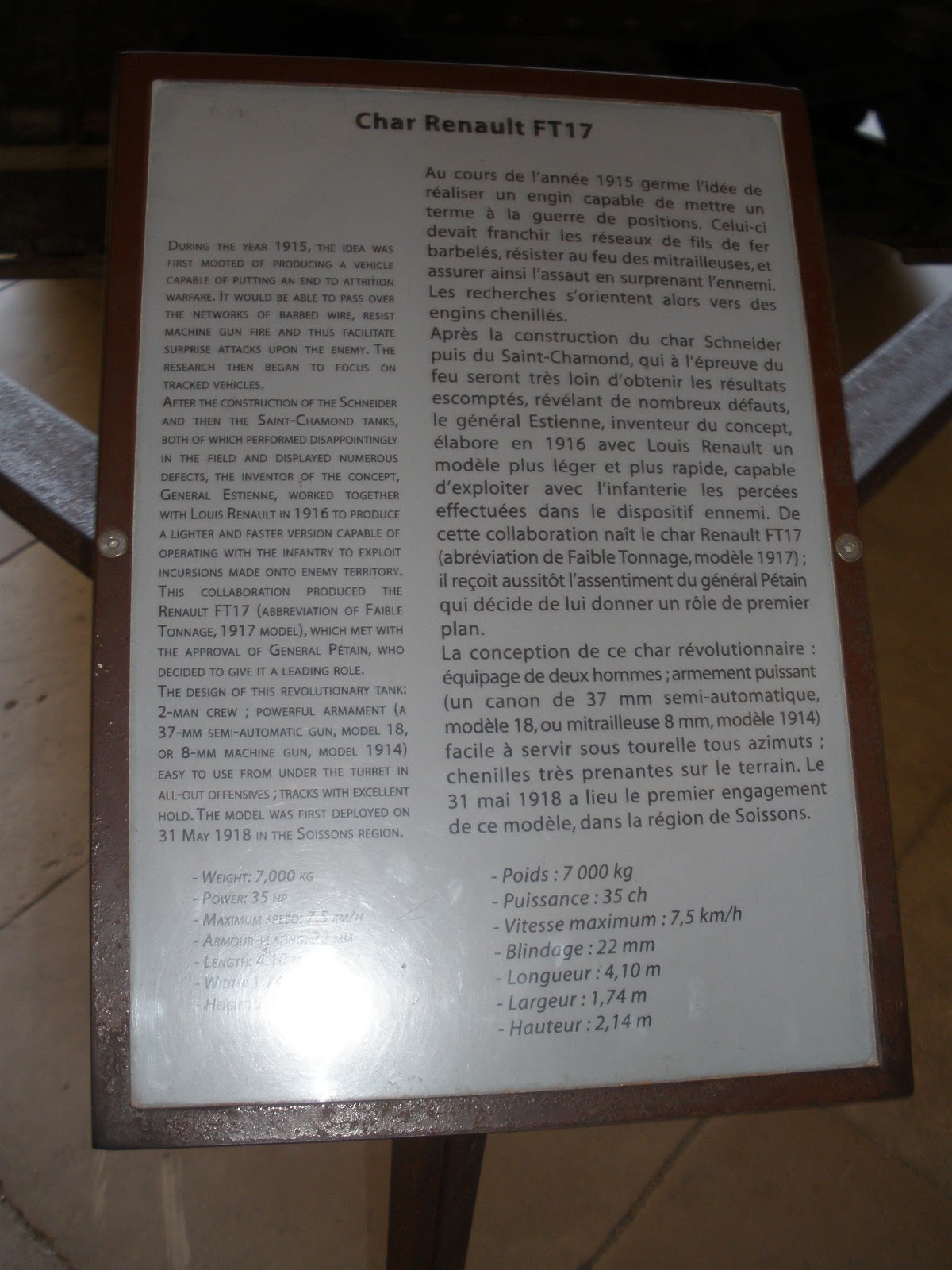
   This Renault FT17 tank is intriguing for many reasons. First, it was manufactured in France and used by American troops. (American weapons manufacturers had tanks on their drawing boards but the war ended before any could be transported to France.) This FT17 held a two-man crew of driver and his gunner who climbed into the rear hatch and sat there to shoot his 37 mm weapon.
    Inside, it was cold and cramped, with the crew wearing leather jerkins to keep warm. Worse, the engine was very loud. As a result, the driver communicated with his gunner by tapping his foot on the back of the driver's head! This tank, first put into service May 30 1918 in the Soissons region, traveled at 6 miles per hour!
Renault FT17
If you care to read the specifications, please do download this picture of plaque description of the Renault's capabilities.
Specs, manufacture of Renault tank FT17.
   Also at the entrance to the World War One rooms is this Canon de Campain. A style used by French military since 1897, this canon was used in World War One.


75 mm French canon manufactured in Bourges in 1918


  The Invalides devotes three areas or rooms to their artifacts of World War One. One for the beginning of the war under command of Marshal Joffre, the second devoted to poilus, or the "hairy ones," the foot soldiers epitomized  by those defending the walled city of Verdun, and the last room devoted to the last months of the war commanded by Marshal Foch. These exhibits I will deal with in my next post. (For detail see the original museum site:
http://www.musee-armee.fr/collections/les-espaces-du-musee/departement-contemporain-les-deux-guerres-mondiales-1871-1945.html )


Sunday, April 21, 2013

Fighting with British at Cantigny, with French near Soissons, video, too!

   
American amputee and nurse, Walter Reed Army Hospital,
U.S. Government, public domain
 For a marvelous movie reel created by the American Signal Corps, please do click on the link to go to YouTube. This marvelous set of stills and reels, done in sepia tones of the period, shows you the American doughboys in the field.
     If you stick with the movie to its conclusion, you will see not only action by artillery and in trenches, but evacuation teams of stretcher bearers, as well as caissons drawn by horses and invasion into a small town, presumably Chateau Thierry.
Go here:
http://youtu.be/PusFK9U51LY