See all my books!

Showing posts with label Les Invalides. Show all posts

Wednesday, June 5, 2013

18+ Days in A.E.F's footsteps: DAY ONE, Part Two, the Invalides' 3 rooms devoted to World War One

Les Invalides, Paris Taxi of 1914, Copyright J. Power
     Les Invalides in Paris is one of the finest and largest museums devoted to exhibiting military equipment.  Spanning many centuries, their collection is awe-inspiring. And this is true of the three rooms devoted to telling the story of La Grande Guerre. (See http://www.musee-armee.fr/accueil.html )
     As you pass from through the multi-media exhibit, you begin to have that heart-rending emotion of sorrow for the tremendous suffering and enormous number of millions dead in this conflict. The exhibit, as you might expect, has a heavy emphasis on the French involvement. In fact, should you as a non-Frenchman ever doubt the degree to which the French soldier fought for victory, viewing the videos, photos, the cannons and the bombs, the medical accoutrement, the plates and spoons, will change your mind forever.
     Here again my photos are sparse and some not so good. Why? I was taking shots without a flash. But a few are stunningly fabulous. The two that stand out are of the Paris Taxi or as they are known in France, The Taxis of the Marne. In September 1914, as German troops advanced so rapidly that the French fell back all the way to Meaux, twenty miles from Paris, the French Army sent out a call for all French troops to report to battle lines along the the northern front. The only way to get there?
     Autos.
     Taxis.
     Parisian taxi drivers answered the call by giving French soldiers a free ride to the front line. Here then is a famous red Parisian taxi which helped to save the day. In long shot and shorter so that you can see the taxi meter (which did not run that day), you get an idea of how many men might have hitched a ride. I have not found a description of the number but just by looking at this car, I'd estimate 3-4 inside and a few hanging off the sides?
Les Invalides, Paris Taxi of 1914, Copyright J. Power

     Most touching were the items that spoke of the needs of men, spiritual and physical. Here we see a French priest's or chaplain's kit for administering the last rites and taking confessions. As I wrote before in this blog, a chaplain had a particularly dangerous and necessary task. He walked out into No Man's Land at night, searching for those who were wounded and who lay in extremis. He often went with a team of stretcher bearers and his job was to find those wounded who might be moved back of the line to receive medical care. For those who were so badly injured that they could not be moved, yet still lived, he administered last rites to them, took their tags and attempted to describe to advance teams back in the trenches where their bodies lay so that they could be returned at a later time for proper burial.
Les Invalides, Chaplain's case, Copyright J. Power
     Another case, startling in its small size, is that of a French field surgeon's. Here we see those items doctors took to the front lines, some even into the trenches, to aid their wounded soldiers.
Les Invalides, French surgeon's field kit, Copyright J. Power
     Less clear are the next few pictures, but I post them anyway for your edification. The startling array of gas masks illustrates in number alone the necessity of protecting oneself from deadly poison gas.  During the war, many types of gas were used by all sides. Each was deadly or debilitating, depending literally on which way the wind blew and how quickly. All soldiers—and yes, nurses and doctors back of the line—drilled daily on getting these ungainly masks on their heads. As opponents made the chemical composition of the gasses more lethal, the gas attacked exposed skin but also seeped through clothing. The gas worked not only by shutting down the function of the lungs by filling the air sacs with deadly fluid, but also created blisters on the skin and in the eyes.

     To Americans, the most famous gas attack on our forces occurred during the Battle of Belleau Wood, June 1917, when our Marines who had gained miles of ground from a German salient along the Marne,  suffered from a large cloud of gas drifting over their lines. For many, the only way out and the only saving grace was the wise move by their leaders to have one Marine, unblinded, instruct his men to stand in a line, one hand on the shoulder of the Marine in front of him, and march out of the Wood.
Les Invalides, Gas masks, Copyright J. Power
     Here in a very bad picture taken through glass is a model to scale of an A.E.F. sterilization truck. Used to sterilize all sorts of equipment and clothing and bedding, these trucks were the first of their kind  to be used in mobile warfare.
Les Invalides, A.E.F. sterilization truck, Copyright J. Power
     Return for Day Two of my 18+ day journey when we go to the newest museum devoted totally to La Grande Guerre in Meaux, France. Better yet, subscribe via RSS feed in the right hand column at top and you will receive my posts into your email box as soon as they go live here.
   Merci! Danke! Thank you.

Thursday, May 23, 2013

18+ days in A.E.F's footsteps: DAY ONE, Part One, Paris and the Invalides' exhibits of World War I


Entrance Gates to Musee de l'Armee, Paris
 No better way to start our trip to the AEF's front lines seemed more logical than to begin in Paris with an overview. (  FYI: All photos here are my own, Copyright 2013, Jo-Ann Power.)
Walkway to entrance

   Yes, hubbie and I had been to the Invalides, the Museum of the French Army, many times before, but this time we went not so much as tourists but now with a solid research purpose.
   As an author who is fascinated with history—and medieval European one of those periods I love learning about—I had to duck into the Medieval Armor exhibit. Yes, we thought we'd start with some fun before I got down to business and the three areas of the museum devoted to the French efforts in World War One. An absolutely mouth-watering array of armor stood before us.
   I was unable to take useful photos inside here. This is true of course in most museums. Flash destroys color and texture of artifacts, even through glass. Because the light is so dim in this exhibit, no camera without flash would have rendered any useful pictures. Instead, I give you here the armor at the entrance to these rooms.
Medieval Armour display, entrance to exhibit, Musee de l'Armee, Paris

   At the entrance to the entire World War One exhibit stand the Renault FT17 tank and French canon, circa 1897-1918.
 
   This Renault FT17 tank is intriguing for many reasons. First, it was manufactured in France and used by American troops. (American weapons manufacturers had tanks on their drawing boards but the war ended before any could be transported to France.) This FT17 held a two-man crew of driver and his gunner who climbed into the rear hatch and sat there to shoot his 37 mm weapon.
    Inside, it was cold and cramped, with the crew wearing leather jerkins to keep warm. Worse, the engine was very loud. As a result, the driver communicated with his gunner by tapping his foot on the back of the driver's head! This tank, first put into service May 30 1918 in the Soissons region, traveled at 6 miles per hour!
Renault FT17
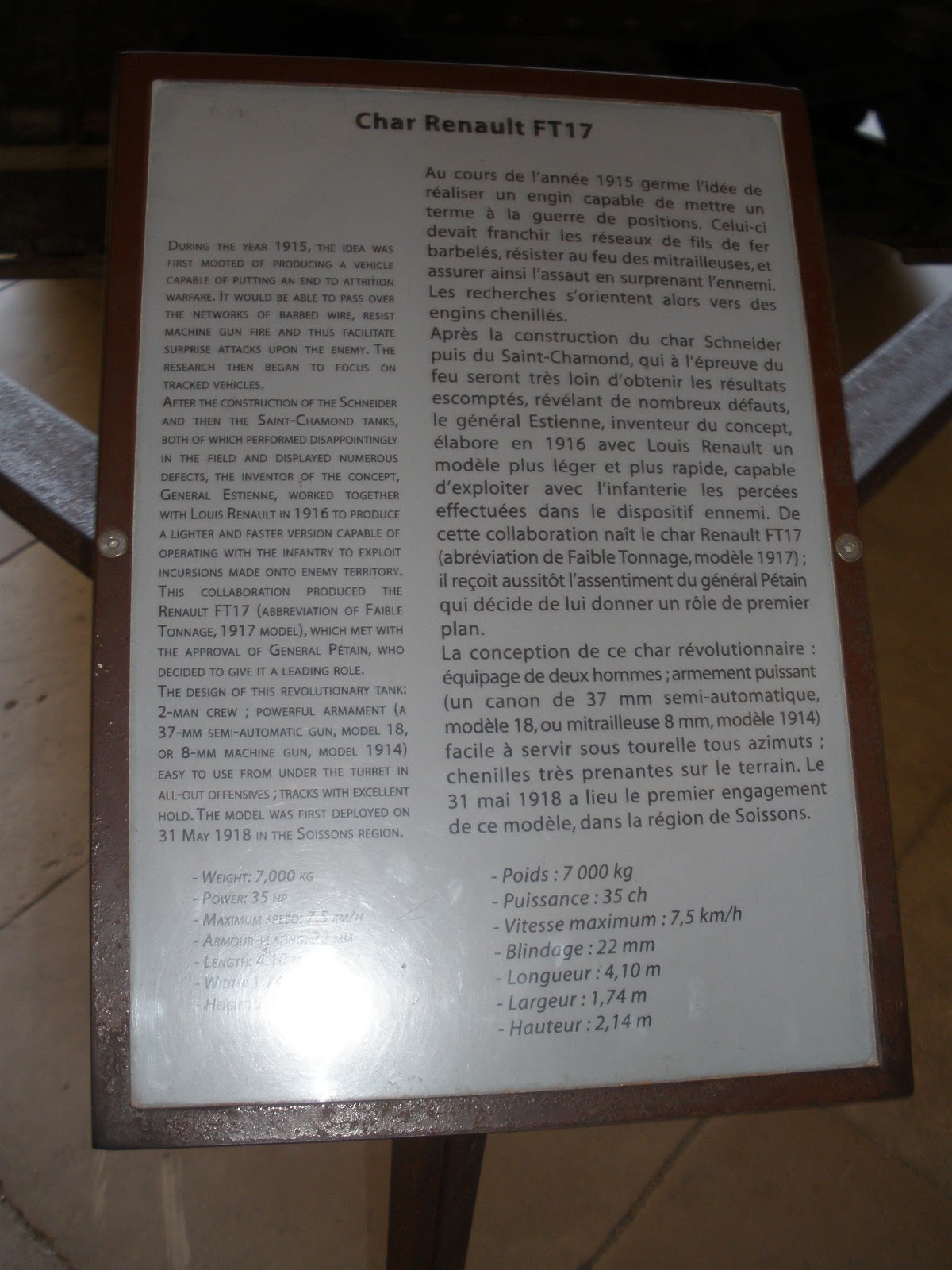
If you care to read the specifications, please do download this picture of plaque description of the Renault's capabilities.
Specs, manufacture of Renault tank FT17.
   Also at the entrance to the World War One rooms is this Canon de Campain. A style used by French military since 1897, this canon was used in World War One.


75 mm French canon manufactured in Bourges in 1918


  The Invalides devotes three areas or rooms to their artifacts of World War One. One for the beginning of the war under command of Marshal Joffre, the second devoted to poilus, or the "hairy ones," the foot soldiers epitomized  by those defending the walled city of Verdun, and the last room devoted to the last months of the war commanded by Marshal Foch. These exhibits I will deal with in my next post. (For detail see the original museum site:
http://www.musee-armee.fr/collections/les-espaces-du-musee/departement-contemporain-les-deux-guerres-mondiales-1871-1945.html )