See all my books!

Showing posts with label WWI museums to visit. Show all posts

Monday, April 28, 2014

Americans in France: HEROIC MEASURES WWI Tour October 2014, 9 days, for Students, Men and Women

Americans in France:
Heroic Measures WWI Journey
9 Days in A.E.F's Footsteps
WWI American Battlefields in France:
A comprehensive tour for men, women and students of Americans' experience in France during The Great War, 1917-1919

   With more than 30 years' researching the American experience in France during The Great War, I lead this tour of the American battlefields of The Great War. Designed for everyone who has an interest in this first massive American military experience abroad, this tour gives you a comprehensive look at the war before the United States declared war in April 1917 until most troops and support services departed in the summer of 1919.

   Managed by prestigious travel corporation KER and DOWNEY, the tour features museums, American battlefields, memorials, and cemeteries with talks by various experts.
   Staff include me as the historical guide, a local French expert and the van driver.

Brief schedule:

Land Only Includes:Oct 13 2014 - Transfer - Meet and Assist at Paris airport (CDG)
Oct 13 2014 - Transfer - Charles De Gaulle airport (CDG) to Paris Hotel
Oct 13 2014 - Excursion - Dinner in Paris
Oct 13 2014 - 1 night in Paris at Marriott Ambassador Opera - Standard Room - BB - 12 x Room
                               - Includes breakfastOct 14 2014 - Transfer - Paris to Compiegne
Oct 14 2014 - Excursion - Visit to the Museum de la Grande Guerre
Oct 14 2014 - Excursion - Dinner at Hotel
Oct 14 2014 - 2 nights in Picardy at Hotel Les Beaux Arts - Standard Room - BB - 12 x Room
                               - Includes breakfastOct 15 2014 - Excursion - Half Day Cantigny Battlefield Tour
Oct 15 2014 - Excursion - Lunch on Excursion
Oct 15 2014 - Excursion - Half Day Armistice Museum Tour
Oct 16 2014 - Excursion - Half Day Oise-Aisne American Cemetery Tour
Oct 16 2014 - Transfer - Compiegne to Reims
Oct 16 2014 - Excursion - Lunch on Excursion
Oct 16 2014 - Excursion - Dinner at Hotel
Oct 16 2014 - 2 nights in Champagne at Hotel de la Paix - Standard Room - BB - 12 x Room
                               - Includes breakfast
Oct 17 2014 - Excursion - Half Day Belleau Woods Battlefield Tour
Oct 17 2014 - Excursion - Lunch on Excursion
Oct 17 2014 - Excursion - Visit to Chateau-Thierry Monument
Oct 18 2014 - Transfer - Reims to Verdun
Oct 18 2014 - Excursion - Dinner at Hotel
Oct 18 2014 - 4 nights in Meuse at Chateau des Monthairons - Standard Room - BB - 12 x Room
                               - Includes breakfastOct 19 2014 - Excursion - Half Day St. Mihiel American Cemetery Tour
Oct 19 2014 - Excursion - Lunch on Excursion
Oct 19 2014 - Excursion - Half Day Mont Sec Memorial Tour
Oct 19 2014 - Excursion - Dinner at Hotel
Oct 20 2014 - Excursion - Half Day Meuse-Argonne Cemetery Tour
Oct 20 2014 - Excursion - Lunch on Excursion
Oct 20 2014 - Excursion - Half Day Montfaucon Memorial Tour
Oct 20 2014 - Excursion - Dinner at Hotel
Oct 22 2014 - Transfer - Verdun to Paris

For more details
Please download the PDF at www.jo-annpower.com 
to read the complete itinerary.
For reservations and more information, please contact:
Trista Gage
Custom Travel Consultant
Tel: +1 (800) 423-4236
Fax: +1 (281) 371 2514
Email: tgage@kerdowney.com
Web: www.kerdowney.com

Wednesday, November 20, 2013

Lafayette Escadrille, Lex Learner in HEROIC MEASURES flies for Army Aero Squadron & beginning of American Air Force

   
Flag with logo
   The volunteers who went to France before the USA declared war in April 1917 were men who had enjoyed the luxury of learning how to fly aeroplanes. Most of these men were college students from well-to-do families. After all, flight instruction was expensive!
   
    Because the United States had declared itself a neutral country, any Americans volunteering had to belong to a "neutral" unit. Hence, they joined the "unofficial" flying unit of the French aero fleet. The French were canny and called it after the famous French aristocrat who had been a leader in the American forces aiding George Washington in the Revolutionary War.

     Aeroplanes were relatively new transportation, produced in greater numbers only at the beginning of the 1910 decade. Planes were fragile, constructed of plywood, a few bits of metal and the gas tank. Those who flew understood that they had to be very cognizant of wind, shear, temperatures and storms. They also knew that once off the ground, flying a mile or two in the air was extremely cold. All those photos we see of men in leather jackets with huge scarves around their necks is no fabrication! They were frozen up there—and suffered colds, pneumonia and massive ear infections as a result. (So does Lex Learner in HEROIC MEASURES!)

     Accidents, too, were very common. Only as manufacturers took advice from experienced pilots did they begin to produce planes that were sturdier and offered more functionality. The Germans produced quite a few models before and during the war, including the Fokker and Junker, both useful in bombing raids. The French produced a few, too, the most famous being the Nieuport, used by our Escadrille and by the men in that unit who transferred to the new US Aero Squardrons when we declared war.

     In wartime, the probability of accidents increased. And as the men of the Escadrille learned from their French cohorts how to fly amid cannon fire, they also learned how to take reconnaissance pictures
and drop bombs. As the war wended on, they also learned how to use the newest of the deadly technology—the machine gun.
Nieuport's were choice of US Aero Squardrons,
light and efficient.

     Life expectancy was short. In fact, most of the men who originally served in the Escadrille died in service. ONe of the few to survive, and one of the most famous, is Eddie Rickenbacker. He went on to found a major airline in the United States. ____
Air Service Map, A.E.F. aerodromes:
The most active squadrons—for bombing raids and surveillance—were stationed
in the northeast sector, near Chaumont, US Headquarters, and employed heavily
in the battles for St. Mihiel and in the Meuse-Argonne drives,
September 1918 through November, 1918.

Sunday, June 9, 2013

18 Days+ in AEF's footsteps: DAY 3: Musee de la Grande Guerre in Meaux, France

Front entrance of musee, Copyright J. Power
http://www.museedelagrandeguerre.eu/en
     Boarding a train from Gare De L'est in Paris, riding for half an hour or so, then boarding a local bus at the Meaux train station is a journey you must take to visit Musee de la Grande Guerre.

     This new museum, opened last year in this charming tiny town northeast of Paris, is comprehensive in its multi-media exhibits and heart-rending to visit.
     What struck me?
     What comes to mind immediately as I write this, almost a month since I was there?

The entrance.
     Stark in its simplicity, the entrance is an opening in this long barricade. Yes, it is a cement barrier. If this is intentional and I suspect it is, this marks your departure from the "normal world" you know to this hell you are about to experience. And your welcome is the abrupt and shocking sound of cannon fire and shells exploding, an air raid siren and wails of others. Then as you move along the path, you hear men marching and a few songs of the period.

The trenches.
     Inside, the curators have built life-size trenches. Standing in the side-views or cut-aways enables you to see the dynamics of the soldiers' challenge.
     Climbing out of them, frightening enough to know you will be exposed and vulnerable, must have required enormous fortitude of mind. Or enormous dedication to the training you received.
     As a woman whose husband is a Vietnam War veteran, I have constantly asked him, over the decades, "What makes you climb over the wall? Or march forward? Or run out beyond cover?" His answer has always been, "Your response is drilled into you. They say, go, and you do. No questions asked."
     Now, long a student of World War One tactics and battlefield conditions, I stood before these trenches and felt my throat close and my heart race. Could I live here? Fight here? Die here?
     The French trenches are a mess. All dirt and barbed wire, these are holes in the ground. The British trench looks, dare I say, tidier. Is this my imagination? No, I examine the replica. It isn't. This has duckboard floors and hard-apacked earth walls. Then I look at the German trench. It is a fortification. Sided by brick-work and steel plates, this trench shows you readily why and how the Germans were able to hold their advance lines for four long years. They fortified their trenches, even dug under them, building some of the most sophisticated underground bunkers many of which still exist today especially in the Meuse area.

Secondly, the men of all the armies and all the countries who fought parade beside you.
Photo from http://www.museedelagrandeguerre.eu/en, Copyright held by Musee.

     Hundreds of life-size men "walk" beside you as you enter the main arena. Eerie, this sensation of striding in the footsteps of ghosts sets your mind to the task of understanding that these millions of men and women fought and died, believing their own cause just and attainable. The uniforms on the figurines seem real. If they are replicas, I did not note. No matter. The impression is that you are among them and you, like they, go to war.

The small items that tell you how these men lived, suffered and died made a mighty impression on me and my husband.
     As an author of fiction, I have known for decades that the way to craft a story is to create what we call in the profession, verisimilitude. A similarity to real life is a necessity to suspend the reader's suspension of disbelief and let him enjoy the story as it should be told from that period of time, that place, that culture.
     Here in Musee, a wealth of items brings that daily existence of these men home to you. What is there here?
     Ah.
     Utensils, broken and battered, to eat with.
     Small tins bowls for soup or stew.
     Chamber pots. Or at worst, wooden boxes with porcelain rims and removable pots beneath.
     A small sewing kit to repair torn uniforms or replace a button.
     Letters to and from men to those at home. Torn, worn, brown with dirt.
    A panorama of scenes depicting French medical care for soldiers:
French stretcher bearers removing wounded soldier from field
Recreation of French surgical team in operation on wounded
USA A.E.F. Surgical kit with Diagnostic Tag booklet

    Pictures of men abound with explanations of care for those with amputations, prosthetic devices (a new art of mechanical invention), and those who suffered wounds to the face and the care of them.
Prosthetics, a new medical specialty developed for those who survived amputations
Variety of prosthetic devices designed during war
Wounds to the head, face and neck could now be treated, but many men needed extensive reconstruction
and others required masks to return to their normal routines after service. This is the beginning of
what we now call plastic surgery.

    Since this is the first war in which medical advances had progressed to the point where many more men could be saved than in previous conflicts, we know there were a large number of men who survived amputation of limbs. Others who incurred facial wounds also survived. For these men, facial reconstruction was a primitive art. Skin grafting was rare and time-consuming, often failing. Masks were the answer for some so that they could resume a life after the war. (I will write of this again in later posts as this is a particular interest of mine.)

The small section of raw motion picture footage was superb.
I will put in a plug and tell you to seek this one out and wait until others have gone so that you may view these clips in their entirety. These clips are rare and I have never seen anything like them anywhere. They are of many different subjects. The ones I recommend are about stretcher bearers, burial teams and the animals in the war, dogs and horses especially.

Meaux is an appropriate setting for this Musee. Meaux was the town to which the Germans advanced farthest toward Paris in their September 1914 drive that we now call The First Battle of the Marne. (Do read my previous post about The Taxis of the Marne for more on this.)

Return for more as we go to Cantigny and begin travel along the A.E.F's front lines and the first Doughboys' victory alongside the British in April 1918.

Do visit the website http://www.museedelagrandeguerre.eu/en  and the Museum.

Thursday, May 23, 2013

18+ days in A.E.F's footsteps: DAY ONE, Part One, Paris and the Invalides' exhibits of World War I


Entrance Gates to Musee de l'Armee, Paris
 No better way to start our trip to the AEF's front lines seemed more logical than to begin in Paris with an overview. (  FYI: All photos here are my own, Copyright 2013, Jo-Ann Power.)
Walkway to entrance

   Yes, hubbie and I had been to the Invalides, the Museum of the French Army, many times before, but this time we went not so much as tourists but now with a solid research purpose.
   As an author who is fascinated with history—and medieval European one of those periods I love learning about—I had to duck into the Medieval Armor exhibit. Yes, we thought we'd start with some fun before I got down to business and the three areas of the museum devoted to the French efforts in World War One. An absolutely mouth-watering array of armor stood before us.
   I was unable to take useful photos inside here. This is true of course in most museums. Flash destroys color and texture of artifacts, even through glass. Because the light is so dim in this exhibit, no camera without flash would have rendered any useful pictures. Instead, I give you here the armor at the entrance to these rooms.
Medieval Armour display, entrance to exhibit, Musee de l'Armee, Paris

   At the entrance to the entire World War One exhibit stand the Renault FT17 tank and French canon, circa 1897-1918.
 
   This Renault FT17 tank is intriguing for many reasons. First, it was manufactured in France and used by American troops. (American weapons manufacturers had tanks on their drawing boards but the war ended before any could be transported to France.) This FT17 held a two-man crew of driver and his gunner who climbed into the rear hatch and sat there to shoot his 37 mm weapon.
    Inside, it was cold and cramped, with the crew wearing leather jerkins to keep warm. Worse, the engine was very loud. As a result, the driver communicated with his gunner by tapping his foot on the back of the driver's head! This tank, first put into service May 30 1918 in the Soissons region, traveled at 6 miles per hour!
Renault FT17
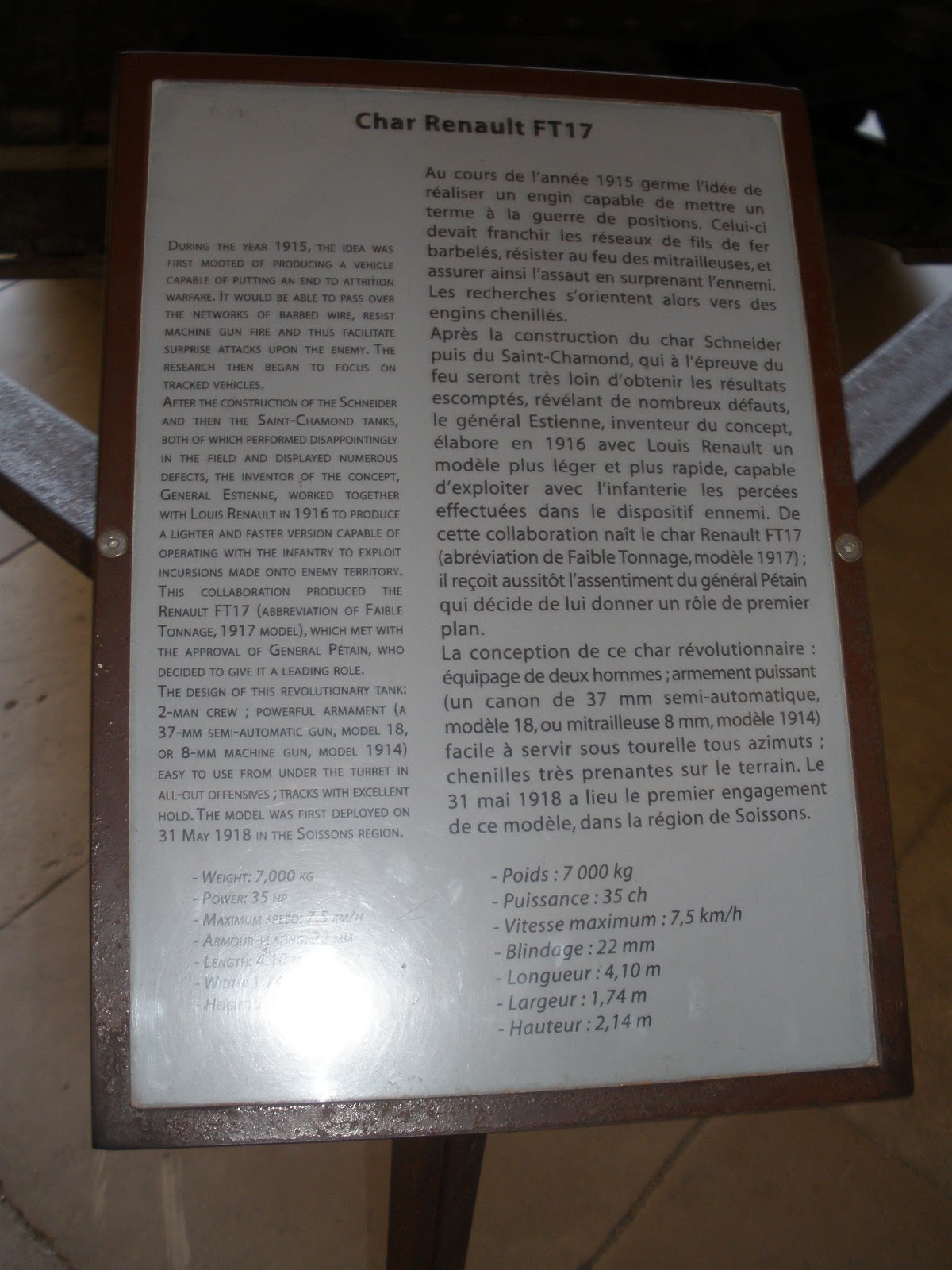
If you care to read the specifications, please do download this picture of plaque description of the Renault's capabilities.
Specs, manufacture of Renault tank FT17.
   Also at the entrance to the World War One rooms is this Canon de Campain. A style used by French military since 1897, this canon was used in World War One.


75 mm French canon manufactured in Bourges in 1918


  The Invalides devotes three areas or rooms to their artifacts of World War One. One for the beginning of the war under command of Marshal Joffre, the second devoted to poilus, or the "hairy ones," the foot soldiers epitomized  by those defending the walled city of Verdun, and the last room devoted to the last months of the war commanded by Marshal Foch. These exhibits I will deal with in my next post. (For detail see the original museum site:
http://www.musee-armee.fr/collections/les-espaces-du-musee/departement-contemporain-les-deux-guerres-mondiales-1871-1945.html )


Monday, May 6, 2013

Invalides, Museum of Army of France, marvelous WWI exhibits

Advertisement for the 1871/1945 Chambers
http://www.musee-armee.fr/en/collections/museum-treasures.html
For those of you pondering visiting the Invalides in Paris, run, do not walk to one of the most marvelous exhibits on World War One.  While most of the parlors devoted to the 1914-1918 conflict center on French Army efforts, the chambers are filled with so many valuable items that I can list only a few.

Before you immerse yourself in the three chambers devoted to three phases of French WWI efforts, do see the tomb of Napoleon Bonaparte. One of the most breath-taking memorial sights in the world (next to the American Tomb of the Unknowns in Arlington, Virginia and the Cenotaph in London, IMHO), the crypt of the man who was the first emperor of the French is truly awe-inspiring.

For a fine and brief introduction to the rest of the Invalides, do watch this film: http://youtu.be/elnbfmDi0T0.

This picture does no justice to the majesty of the crypt.
Official photo of Musee-Armee,
http://www.musee-armee.fr/en/collections/
For the memorial to Marshal Foch, the third and last French commander during the war, I will do that more justice with a separate post. But here it is in the Dome of the Invalides.
Copyright, 2011, A. Power.