See all my books!

Sunday, June 16, 2013

18+ days in AEF's footsteps: Day 4, Cantigny

Soldier of the First Division
One side of the hilltop of Cantigny, France
         Cantigny is a tiny village in the French countryside north of Paris. The tranquil village surrounds the mountain top. At most, twenty homes dot the crown. Most are farmhouses. One church stands amid them.

     In May 1918, just as the American Expeditionary Force was arriving in great numbers, the French faced a formidable attack by Germans. This offensive, part of huge drive by the German forces to win the war before the Americans could arrive in great numbers, was the first of many such efforts along the front lines.
     The First Division, or as it is now known the First Army or Big Red One, came from the south to push the German line back toward the north.
     While it is not my attempt here to describe the battle in any detail (I leave that to your own search of good military records), I will tell you that as the Americans joined the French in this hotly contested area this battle was the first fought by AEF and won by them. It is the first in which the German Army and their general staff took note of American strengths and strategies and it is the first in which the AEF's wounded were aided by the first of the medical teams to sail to France. (For a superb description of the battle, please go to this source: The First Division Museum in Wheaton, Illinois, http://www.firstdivisionmuseum.org/museum/online/toward_the_front/battle_of_cantigny/default.aspx
One road atop the hill village of Cantigny.
Notice the blue sign!
The Avenue of the First Division, U.S.A.
     I can show you many pictures of this locale. But I can also tell you that for those who wish to see why a certain spot becomes a battleground, this town exemplifies the importance of that. As you stand on this hilltop and look 360 degrees into the surrounding valley south and north to the plain, you realize that this town afforded a great view of the distances in all directions. The roads lead to many strategic places, including the larger town nearby, Montdidier. Here is a picture of the valley across which AEF forces advanced uphill to take and hold the town.
Valley to south of Cantigny, peaceful today and a farm.


    The destroyed village of Cantigny exemplifies the devastation of these campaigns on the people who lived here.
USA, Army photo, Public Domain


    Commemorating the effort of the First Division is this bronze statue of an AEF soldier. An explanation of the battle is accompanied by a map. Please do download the picture to enlarge the type and read the explanation of the battle.


Description of battle.
Atop the hill are other monuments to the men who fought here. In a circle of shrubs and trees is this tall monument. You can see here the view of the church on the hill.
You can view easily the American eagles here on the sides of this monument.
Another view of the monument.

     At one end of this grove atop the hill is this cross and the memorial flowers.

     As we left the village to have lunch in Montdidier and to return to our B&B in Compiegne, we spotted this monument. At first, thinking it a French memorial, we passed it. Every French town has one or more of these obelisks to those of their own countrymen who fought and died in La Grande Guerre. But we thought we spotted an eagle on top of the memorial and so we our drove back to great reward! Here is another memorial to the First Division and their heroic efforts in the Spring Offensive of 1918.

Memorial to First Division in Battle of Cantigny, south of the hill town.
AEF Map, Public domain


Sunday, June 9, 2013

18 Days+ in AEF's footsteps: DAY 3: Musee de la Grande Guerre in Meaux, France

Front entrance of musee, Copyright J. Power
http://www.museedelagrandeguerre.eu/en
     Boarding a train from Gare De L'est in Paris, riding for half an hour or so, then boarding a local bus at the Meaux train station is a journey you must take to visit Musee de la Grande Guerre.

     This new museum, opened last year in this charming tiny town northeast of Paris, is comprehensive in its multi-media exhibits and heart-rending to visit.
     What struck me?
     What comes to mind immediately as I write this, almost a month since I was there?

The entrance.
     Stark in its simplicity, the entrance is an opening in this long barricade. Yes, it is a cement barrier. If this is intentional and I suspect it is, this marks your departure from the "normal world" you know to this hell you are about to experience. And your welcome is the abrupt and shocking sound of cannon fire and shells exploding, an air raid siren and wails of others. Then as you move along the path, you hear men marching and a few songs of the period.

The trenches.
     Inside, the curators have built life-size trenches. Standing in the side-views or cut-aways enables you to see the dynamics of the soldiers' challenge.
     Climbing out of them, frightening enough to know you will be exposed and vulnerable, must have required enormous fortitude of mind. Or enormous dedication to the training you received.
     As a woman whose husband is a Vietnam War veteran, I have constantly asked him, over the decades, "What makes you climb over the wall? Or march forward? Or run out beyond cover?" His answer has always been, "Your response is drilled into you. They say, go, and you do. No questions asked."
     Now, long a student of World War One tactics and battlefield conditions, I stood before these trenches and felt my throat close and my heart race. Could I live here? Fight here? Die here?
     The French trenches are a mess. All dirt and barbed wire, these are holes in the ground. The British trench looks, dare I say, tidier. Is this my imagination? No, I examine the replica. It isn't. This has duckboard floors and hard-apacked earth walls. Then I look at the German trench. It is a fortification. Sided by brick-work and steel plates, this trench shows you readily why and how the Germans were able to hold their advance lines for four long years. They fortified their trenches, even dug under them, building some of the most sophisticated underground bunkers many of which still exist today especially in the Meuse area.

Secondly, the men of all the armies and all the countries who fought parade beside you.
Photo from http://www.museedelagrandeguerre.eu/en, Copyright held by Musee.

     Hundreds of life-size men "walk" beside you as you enter the main arena. Eerie, this sensation of striding in the footsteps of ghosts sets your mind to the task of understanding that these millions of men and women fought and died, believing their own cause just and attainable. The uniforms on the figurines seem real. If they are replicas, I did not note. No matter. The impression is that you are among them and you, like they, go to war.

The small items that tell you how these men lived, suffered and died made a mighty impression on me and my husband.
     As an author of fiction, I have known for decades that the way to craft a story is to create what we call in the profession, verisimilitude. A similarity to real life is a necessity to suspend the reader's suspension of disbelief and let him enjoy the story as it should be told from that period of time, that place, that culture.
     Here in Musee, a wealth of items brings that daily existence of these men home to you. What is there here?
     Ah.
     Utensils, broken and battered, to eat with.
     Small tins bowls for soup or stew.
     Chamber pots. Or at worst, wooden boxes with porcelain rims and removable pots beneath.
     A small sewing kit to repair torn uniforms or replace a button.
     Letters to and from men to those at home. Torn, worn, brown with dirt.
    A panorama of scenes depicting French medical care for soldiers:
French stretcher bearers removing wounded soldier from field
Recreation of French surgical team in operation on wounded
USA A.E.F. Surgical kit with Diagnostic Tag booklet

    Pictures of men abound with explanations of care for those with amputations, prosthetic devices (a new art of mechanical invention), and those who suffered wounds to the face and the care of them.
Prosthetics, a new medical specialty developed for those who survived amputations
Variety of prosthetic devices designed during war
Wounds to the head, face and neck could now be treated, but many men needed extensive reconstruction
and others required masks to return to their normal routines after service. This is the beginning of
what we now call plastic surgery.

    Since this is the first war in which medical advances had progressed to the point where many more men could be saved than in previous conflicts, we know there were a large number of men who survived amputation of limbs. Others who incurred facial wounds also survived. For these men, facial reconstruction was a primitive art. Skin grafting was rare and time-consuming, often failing. Masks were the answer for some so that they could resume a life after the war. (I will write of this again in later posts as this is a particular interest of mine.)

The small section of raw motion picture footage was superb.
I will put in a plug and tell you to seek this one out and wait until others have gone so that you may view these clips in their entirety. These clips are rare and I have never seen anything like them anywhere. They are of many different subjects. The ones I recommend are about stretcher bearers, burial teams and the animals in the war, dogs and horses especially.

Meaux is an appropriate setting for this Musee. Meaux was the town to which the Germans advanced farthest toward Paris in their September 1914 drive that we now call The First Battle of the Marne. (Do read my previous post about The Taxis of the Marne for more on this.)

Return for more as we go to Cantigny and begin travel along the A.E.F's front lines and the first Doughboys' victory alongside the British in April 1918.

Do visit the website http://www.museedelagrandeguerre.eu/en  and the Museum.

Wednesday, June 5, 2013

18+ Days in A.E.F's footsteps: DAY ONE, Part Two, the Invalides' 3 rooms devoted to World War One

Les Invalides, Paris Taxi of 1914, Copyright J. Power
     Les Invalides in Paris is one of the finest and largest museums devoted to exhibiting military equipment.  Spanning many centuries, their collection is awe-inspiring. And this is true of the three rooms devoted to telling the story of La Grande Guerre. (See http://www.musee-armee.fr/accueil.html )
     As you pass from through the multi-media exhibit, you begin to have that heart-rending emotion of sorrow for the tremendous suffering and enormous number of millions dead in this conflict. The exhibit, as you might expect, has a heavy emphasis on the French involvement. In fact, should you as a non-Frenchman ever doubt the degree to which the French soldier fought for victory, viewing the videos, photos, the cannons and the bombs, the medical accoutrement, the plates and spoons, will change your mind forever.
     Here again my photos are sparse and some not so good. Why? I was taking shots without a flash. But a few are stunningly fabulous. The two that stand out are of the Paris Taxi or as they are known in France, The Taxis of the Marne. In September 1914, as German troops advanced so rapidly that the French fell back all the way to Meaux, twenty miles from Paris, the French Army sent out a call for all French troops to report to battle lines along the the northern front. The only way to get there?
     Autos.
     Taxis.
     Parisian taxi drivers answered the call by giving French soldiers a free ride to the front line. Here then is a famous red Parisian taxi which helped to save the day. In long shot and shorter so that you can see the taxi meter (which did not run that day), you get an idea of how many men might have hitched a ride. I have not found a description of the number but just by looking at this car, I'd estimate 3-4 inside and a few hanging off the sides?
Les Invalides, Paris Taxi of 1914, Copyright J. Power

     Most touching were the items that spoke of the needs of men, spiritual and physical. Here we see a French priest's or chaplain's kit for administering the last rites and taking confessions. As I wrote before in this blog, a chaplain had a particularly dangerous and necessary task. He walked out into No Man's Land at night, searching for those who were wounded and who lay in extremis. He often went with a team of stretcher bearers and his job was to find those wounded who might be moved back of the line to receive medical care. For those who were so badly injured that they could not be moved, yet still lived, he administered last rites to them, took their tags and attempted to describe to advance teams back in the trenches where their bodies lay so that they could be returned at a later time for proper burial.
Les Invalides, Chaplain's case, Copyright J. Power
     Another case, startling in its small size, is that of a French field surgeon's. Here we see those items doctors took to the front lines, some even into the trenches, to aid their wounded soldiers.
Les Invalides, French surgeon's field kit, Copyright J. Power
     Less clear are the next few pictures, but I post them anyway for your edification. The startling array of gas masks illustrates in number alone the necessity of protecting oneself from deadly poison gas.  During the war, many types of gas were used by all sides. Each was deadly or debilitating, depending literally on which way the wind blew and how quickly. All soldiers—and yes, nurses and doctors back of the line—drilled daily on getting these ungainly masks on their heads. As opponents made the chemical composition of the gasses more lethal, the gas attacked exposed skin but also seeped through clothing. The gas worked not only by shutting down the function of the lungs by filling the air sacs with deadly fluid, but also created blisters on the skin and in the eyes.

     To Americans, the most famous gas attack on our forces occurred during the Battle of Belleau Wood, June 1917, when our Marines who had gained miles of ground from a German salient along the Marne,  suffered from a large cloud of gas drifting over their lines. For many, the only way out and the only saving grace was the wise move by their leaders to have one Marine, unblinded, instruct his men to stand in a line, one hand on the shoulder of the Marine in front of him, and march out of the Wood.
Les Invalides, Gas masks, Copyright J. Power
     Here in a very bad picture taken through glass is a model to scale of an A.E.F. sterilization truck. Used to sterilize all sorts of equipment and clothing and bedding, these trucks were the first of their kind  to be used in mobile warfare.
Les Invalides, A.E.F. sterilization truck, Copyright J. Power
     Return for Day Two of my 18+ day journey when we go to the newest museum devoted totally to La Grande Guerre in Meaux, France. Better yet, subscribe via RSS feed in the right hand column at top and you will receive my posts into your email box as soon as they go live here.
   Merci! Danke! Thank you.

Thursday, May 23, 2013

18+ days in A.E.F's footsteps: DAY ONE, Part One, Paris and the Invalides' exhibits of World War I


Entrance Gates to Musee de l'Armee, Paris
 No better way to start our trip to the AEF's front lines seemed more logical than to begin in Paris with an overview. (  FYI: All photos here are my own, Copyright 2013, Jo-Ann Power.)
Walkway to entrance

   Yes, hubbie and I had been to the Invalides, the Museum of the French Army, many times before, but this time we went not so much as tourists but now with a solid research purpose.
   As an author who is fascinated with history—and medieval European one of those periods I love learning about—I had to duck into the Medieval Armor exhibit. Yes, we thought we'd start with some fun before I got down to business and the three areas of the museum devoted to the French efforts in World War One. An absolutely mouth-watering array of armor stood before us.
   I was unable to take useful photos inside here. This is true of course in most museums. Flash destroys color and texture of artifacts, even through glass. Because the light is so dim in this exhibit, no camera without flash would have rendered any useful pictures. Instead, I give you here the armor at the entrance to these rooms.
Medieval Armour display, entrance to exhibit, Musee de l'Armee, Paris

   At the entrance to the entire World War One exhibit stand the Renault FT17 tank and French canon, circa 1897-1918.
 
   This Renault FT17 tank is intriguing for many reasons. First, it was manufactured in France and used by American troops. (American weapons manufacturers had tanks on their drawing boards but the war ended before any could be transported to France.) This FT17 held a two-man crew of driver and his gunner who climbed into the rear hatch and sat there to shoot his 37 mm weapon.
    Inside, it was cold and cramped, with the crew wearing leather jerkins to keep warm. Worse, the engine was very loud. As a result, the driver communicated with his gunner by tapping his foot on the back of the driver's head! This tank, first put into service May 30 1918 in the Soissons region, traveled at 6 miles per hour!
Renault FT17
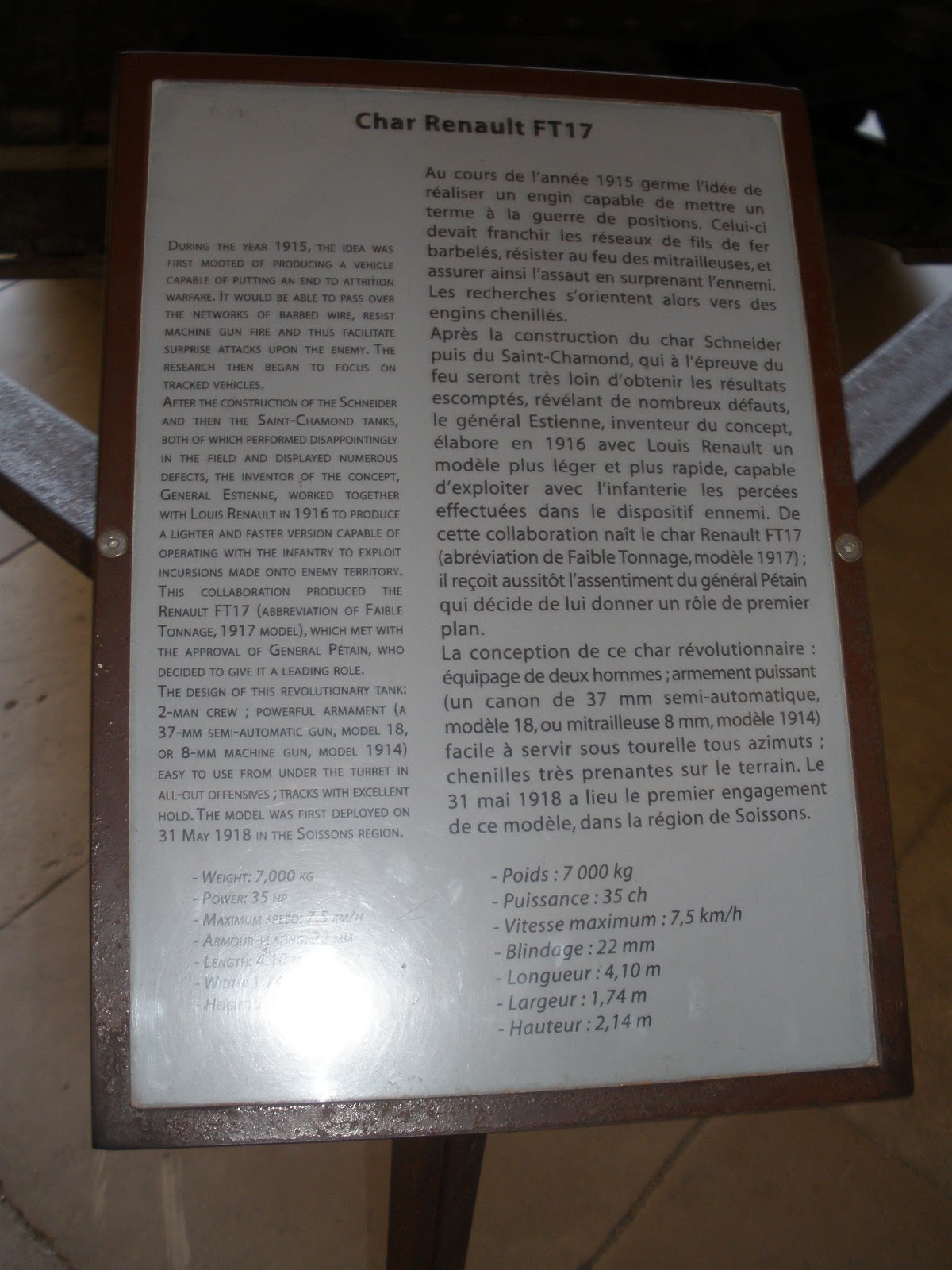
If you care to read the specifications, please do download this picture of plaque description of the Renault's capabilities.
Specs, manufacture of Renault tank FT17.
   Also at the entrance to the World War One rooms is this Canon de Campain. A style used by French military since 1897, this canon was used in World War One.


75 mm French canon manufactured in Bourges in 1918


  The Invalides devotes three areas or rooms to their artifacts of World War One. One for the beginning of the war under command of Marshal Joffre, the second devoted to poilus, or the "hairy ones," the foot soldiers epitomized  by those defending the walled city of Verdun, and the last room devoted to the last months of the war commanded by Marshal Foch. These exhibits I will deal with in my next post. (For detail see the original museum site:
http://www.musee-armee.fr/collections/les-espaces-du-musee/departement-contemporain-les-deux-guerres-mondiales-1871-1945.html )


Tuesday, May 14, 2013

18 days in the A.E.F's footsteps: Remembrance of our Doughboys, their devotion and sacrifices as compared to those who fought in WWII

Steve and I in gardens of our B&B, Chateau Marjolaine in Chateau Thierry.
Do note behind us flows the gentle Marne, which millions of men and
women fought, suffered and died to ensure that we might enjoy it in peace.
As my husband and I traveled through France, we met many French and Americans who asked us why few Americans seem to value or understand the devotion of those who fought in the Great War.

As I write, hundreds in Great Britain ask this question of themselves. Many in the UK wonder if their own planned Centennial events will resurrect anti-German sentiment and/or focus too much on the sadness and futility that has come to be the watchword for all those who gave their lives, their fortunes and their sacred honor to fight in that conflict.
How can we be surprised at this? Frankly, what we teach is what we get repeated back to us. I myself taught high school and college history and know that (especially in public schools) you go with what is written in the course outline and the textbooks and understand that people remember those themes and morals taught to them by word, picture and repetition.

To be specific to the Americans' remembrances and concepts of the Great War effort, I offer my own humble thoughts on this issue. I serve them up not as an academic historian, yet as a professionally trained one and a credentialed one. I also list them because I am a novelist and I see the dynamics of public consciousness through the prism of entertainment, most notably books, fiction and non, offered for sale to the American public.

With those caveats in mind, I suggest that the average American knows only a few things about the Great War. I suggest that this is a result of, and certainly not limited to, the following:

1. In the public mind since the 1998 debut of the very popular and heart-wrenching film "SAVING PRIVATE RYAN" and Tom Brokaw's book "THE GREATEST GENERATION" in 2001, those who fought in World War Two changed the world for good. They fought against foes who exhibited radical, racist practices that were anti-democratic and therefore, "deserved" to be eradicated.

We get the concept here that this war was a "Good War." It was heroic, demanding and those who sacrificed did it for noble causes. Because these men and women won this war, they deserved all honor and glory.

Conclusion: Those who fought in World War One may have been brave, may have been heroic, but they fought and won a war that solved nothing and only made matters worse by enabling radicals to rise to power.

Furthermore, I quote and condense from so many I have met over the decades, "World War One is depressing. The generals had no idea what they were doing and too many died for nothing."

2. "Boomers", i.e. the children of those men and women who fought in World War Two, are the consumers of that film and its successors, like "BAND OF BROTHERS" and various others focusing on the war in Europe and war in the Pacific, are the ones who saw those films and read those books.

Conclusion: Boomers are the ones most likely to honor their own parents who fought in that war. They are most likely to have heard the stories of battles won. They are the ones most likely to understand what was at stake. They are the ones who revere what their parents did to transform the American concept of the world and believe that it is Americans' duty to lead the world and prohibit wars.

3. Boomers are the ones who for the past 4-5 decades generationally controlled the school curriculums, wrote the textbooks, ran the Memorial Day and Armistice Day events in the USA. They controlled the concepts taught to children and to the public at large about both World Wars.

Conclusion: Boomers' perspective is that those who fought in World War One were brave and heroic, but their sacrifices mattered little. The world became a worse place. The Greatest Generation finished the work the previous one did not accomplish.

4. "Boomers" have been for more than 3 decades the consumers who buy books more than any other age group.

  • They are the ones with the highest literacy rate.
  • They are the ones with the most money. (This is especially true since the 2008 financial crisis where, in USA, those who retain their basic wealth are most likely to be over 60 years of age.) I could quote numerous studies on this, sponsored by governmental and financial institutions, but I wish to be brief and encourage you to look for the proofs which I know are there. After all, I am a Boomer myself!)
  • They are also the ones who were taught in high school and college that World War One was futile by being required to read the literature written by those who lived during that period. Boomers have read "ALL QUIET ON THE WESTERN FRONT" and "A FAREWELL TO ARMS." Both books speak of the raw horror of war and its futility in general.
  • To pour on more despair, we could add the other novels of the post-WWI generation, all of which speak of ennui and futility. Here I include many of the works of Hemingway (FOR WHOM THE BELL TOLLS, THE SUN ALSO RISES) and Fitzgerald (THE BEAUTIFUL AND THE DAMNED, THE GREAT GATSBY, TENDER IS THE NIGHT).

Conclusion: What the Boomers know and feel, they have taught their children: World War One produced a lost generation of aimless, self-interested people who never got their act together. The result was another war that had to be fought and won. Grandpa and Grandma did that.

5. "Boomers" are active readers. They buy a lot of books. In fact of all age groups, they buy the most books in stores and now, on line.

  • Yes, American men read newspapers and magazines, and to them books come third. They buy thrillers, mysteries and World War Two action adventure plus now stories of current war. 
  • But the ones who buy the most books are women. What do women buy? Studies for years by various groups, including national writers organizations, show us that every time a woman walks into a book store, she buys at least 1 book and more often she will buy 2-3. Usually, she is a destination shopper, one with a purpose. She may buy a gift (for a family member), or a specific type of book like a travel guide or a cook book, and she will buy at least one paperback for herself. That paperback is fiction. It is also usually what we call in the trade, women's fiction which includes romance and historical romance.
  • Women are the cultural transmitters within their families. They teach social mores, concepts and themes to their children. For a woman reader and her family, this truth stands: If you are what you read, then so are your children.

Conclusion: Until recently when publishers in the UK and Commonwealth countries began to predict their own increased public interest in World War One period, books about it were few and tended to be non-fiction. As more are published, women readers will learn more and perhaps the attitudes toward the war in the USA will begin to change.

While you may now accuse me of carrying a banner to encourage a greater interest and respect for those who gave their all in 1917 and 1918, I will respond by asking, "Why not?"

Last week, when my husband and I stood amid the sea of 4000+ graves of our men and women buried in the St. Mihiel Cemetery near Thiacourt and we asked the administrator how many come here to Eastern France to pay their respects, her response was, "Not enough. Most Americans visit Normandy."

It is time we Americans broadened our horizons, traveled more broadly and thought about war more critically.

Friday, May 10, 2013

2 weeks+ in the footsteps of the A.E.F. front lines!

Climbing up out of jet lag, I begin a series of articles here about the heart-rending, exciting, endearing and oh so informative 18 day trip my husband and I took to France to imbibe details of the American Expeditionary Forces' routes in 1917-1918.

My husband Steve was my right arm and hand, my interpreter, my expert photographer and my chauffeur for this marvelous event. (To add also, that he is my wine expert and...yes, arbiter of all things funny is quite essential to the telling of this tale—and to the completion of this trip.) He was and is invaluable to me in finishing the research for this novel. In fact, I would not have undertaken writing it again had he not insisted that the time was right, that the Centenary of the war was the appropriate moment to ensure that HEROIC MEASURES found the readership that it deserves. Next to him was my dear cousin Kathleen who also read the book decades ago and who loved it then and who is delighted it will see air now.

As a trained historian who has written 18 novels, I know the value of proper research. I also value the essence of truth it imparts to the finished work. And as one who has also written mysteries where the importance of forensic and police procedure is imperative to the veracity of the story, I know that the smallest details are the ones that make a novel live.

What a person wears, how she feels as she boards a ship, or even what she eats helps to set a scene and give the reader the ever valued verisimilitude vital to the plot and characterization.

Here in HEROIC MEASURES, what I will give you are these facts, among others:

  • Not just what my heroine wears, but why and how it feels, how she acquired it and yes, paid for it herself!
  • What kind of ship she boards when she sails out in the dead of night from an American port—and why she cannot even learn the name of the ship!
  • What she will sleep in on that ship. Hint: It is not a plush cabin bunk.
  • Where she will get off that ship and how she will travel from the French port to the site where she first nurses the wounded who fought on the hills near Cantigny.
  • What Cantigny looks like
  • Why she is there with A.E.F. and the British troops in the Somme Sector
  • How she is trained to nurse the wounded
  • What materials she has at her disposal. Hint: Penicillin was not yet invented.
  • How she must have felt to go on leave to Paris through Gare de l'est and see thousands of refugees fleeing the north with only the goods they could carry in their arms.

And yes, there is more, much more to this story, so I will lure you in to read more about precisely where we went. For brevity and for those who follow here who are vitally interested in World War One and our devotion to the wounded American Doughboy and Marines, I will tell you here we went to:

  • Paris
  • Compiegne
  • Cantigny
  • Montdidier
  • Belleau Wood
  • Chateau Thierry
  • Ouise-Aisne
  • St. Mihiel, Montsec, Thiacourt
  • Verdun, Fort Douamont and the Citadel
  • Meuse-Argonne, including Montfaucon, Varennes and many other hamlets where our men fought and died and prevailed.

Please return for photos, videos and insights. I will do my best to relate to you the sights, the smells, the environment where more than 1 million Americans, men and women, devoted their lives and their honor to accomplishing the goal of winning the war.

Today, when we Americans think of that war, we owe these men and women the same respect and honor we give to our other men and women in uniform, past and present. After all, these Americans won that war. It was not they who lost the peace.

If this Centennial teaches any moral, I hope the first one, the strongest one we claim is that these men and women fought and did themselves and their cause proud. If the Great War has been branded as sad or senseless, then it was not these men and women who made it so. We owe them the remembrance of what was a heroic measure to go when called, to serve when asked, to devote all to accomplish that goal and to contribute mightily to end a conflict which began too easily, endured too long and ended in a peace which should have been more just, less vengeful.


Monday, May 6, 2013

Invalides, Museum of Army of France, marvelous WWI exhibits

Advertisement for the 1871/1945 Chambers
http://www.musee-armee.fr/en/collections/museum-treasures.html
For those of you pondering visiting the Invalides in Paris, run, do not walk to one of the most marvelous exhibits on World War One.  While most of the parlors devoted to the 1914-1918 conflict center on French Army efforts, the chambers are filled with so many valuable items that I can list only a few.

Before you immerse yourself in the three chambers devoted to three phases of French WWI efforts, do see the tomb of Napoleon Bonaparte. One of the most breath-taking memorial sights in the world (next to the American Tomb of the Unknowns in Arlington, Virginia and the Cenotaph in London, IMHO), the crypt of the man who was the first emperor of the French is truly awe-inspiring.

For a fine and brief introduction to the rest of the Invalides, do watch this film: http://youtu.be/elnbfmDi0T0.

This picture does no justice to the majesty of the crypt.
Official photo of Musee-Armee,
http://www.musee-armee.fr/en/collections/
For the memorial to Marshal Foch, the third and last French commander during the war, I will do that more justice with a separate post. But here it is in the Dome of the Invalides.
Copyright, 2011, A. Power.


Wednesday, May 1, 2013

Gas attacks, Belleau Wood, effects, treatment and recovery, June 1918

Gas victims, walking out of battlefield,
Public Domain,

National Archives photo, courtesy of the Indiana War Memorial
     Belleau Wood is one of the most famous of the American Marine Corps' battles (June 1-28 1918).
    Remembered for the victory that was theirs, the Marines also mark this battle for the German use of mustard gas on them.
     With more than 2,000 Marines inhaling the poisonous mustard gas that blinded as it burned the skin and lungs, the Marines who survived the attack came out of the woods only by standing one man in back of the other, one hand to the man in front of them, and walking out of the danger zone.


     Various types of chemical gas compounds were used by both sides during the war. Some were more damaging than others. The worst, the mustard gas of the latter years, blistered the skin and the eyes. Worse, the gas inflamed the lungs making breathing impossible. But the gas also permeated clothing.
     The American Marine Corps fighting at Belleau Wood in June 1918 suffered heavy casualties from gas warfare. Here in the next picture, we see a nurse at a clearing station administering drops to the eyes of a Marine affected with gas. The sooner the wounded received these drops, the more likely he was to regain his sight.
American nurse administering eye drops to a Marine.
U.S. public domain, recruiting poster

This engagement at Belleau Wood was one of the most difficult for the U.S. Marine Corps during the war. Still named as one of the Corps' greatest victories, the men fought so fiercely that the Germans called them, Teufel Hunden, or Devil Dogs. Inspiring a recruiting poster in the United States, the Marines commemorated the bravery of their corpsmen by maintaining a museum at Belleau Wood which they have appropriately named, The Devil Dog Museum.
Here we see one Canadian solider affected by mustard gas. Chances of total recovery depended on concentration of gas the soldier was exposed to and the speed with which he was treated.
Canadian government photo, in public domain.


Sunday, April 21, 2013

Fighting with British at Cantigny, with French near Soissons, video, too!

   
American amputee and nurse, Walter Reed Army Hospital,
U.S. Government, public domain
 For a marvelous movie reel created by the American Signal Corps, please do click on the link to go to YouTube. This marvelous set of stills and reels, done in sepia tones of the period, shows you the American doughboys in the field.
     If you stick with the movie to its conclusion, you will see not only action by artillery and in trenches, but evacuation teams of stretcher bearers, as well as caissons drawn by horses and invasion into a small town, presumably Chateau Thierry.
Go here:
http://youtu.be/PusFK9U51LY

Sunday, April 7, 2013

First aid to American wounded soldiers, where, when, how

     A wounded soldier passed through many posts as he was removed from the front. Some of these travels took, sadly, days. Stories abound of men left on the ground in rain, snow and sleet as medical teams walked among them to analyze the severity of their injuries and determine how quickly and where they might be evacuated for treatment. Many men waited close behind the front lines, hearing the sound of the guns, bombs and airplane strikes that hurt them and their fellow soldiers even as they lay wounded. In fact, many doctors and nurses lamented that had they been able to treat their patients sooner, the men would have had a higher rate of survival and faster recovery. (In fact, improving the immediacy of treatment for a wounded soldier was the foremost goal of medical response teams throughout the war by all combatants and was implemented and improved on in each succeeding war.)

     When a soldier was wounded, he was assisted to the first aid station, dressing station or casualty clearing station by his pals or by stretcher bearers. (These first stops along the route backward from a front lines had many names and saw many variations, depending on numbers of medical teams, type of equipment and surgical and nursing specialists available. Triage was a function at each stage back of the line.) But before he got to such a station, the solider had in his possession a field dressing. (I have not yet found a U.S. field dressing picture. If anyone knows of one, I would heartily appreciate the url.)
    Here, courtesy of the British site, The Warwicks 1914-1918 (http://thewarwicks1418.com), I show you their First Field Dressing, FFD and their description:
Courtesy of and Copyright to  http://thewarwicks1418.com

"First Field Dressing (FFD) and Iodine ampoule carried on Active Service inside the lower right of the jacket."

Applied by the soldier himself or by those near him (if capable), this dressing consisted of iodine, the only easily packaged and affordable antiseptic/cleansing agent at the time. Penicillin was not yet used as a means to kill bacteria. Morphine was not readily available at the front lines, only backward of the line.
French church opened as ward used by Field Hospital #1, 2nd Division, June 16, 1918

   The next receiving station was a more intensive care unit. This post was a Mobile Hospital unit, literally moving by truck to one to four miles in back of an active front. This included a surgical team of doctors, nurses, and nurses assistants (what we would call orderlies) and/or stretcher bearers who were generally able-bodied types to carry wounded men. This mobile unit team, in the case of American facilities, assessed soldiers and divided them according to type of wound or disability. A team of doctors and nurses assessed each soldier and sent him either to surgery (in order of severity of wounds and operability), to a mental health receiving station or to a hospital treating only those with diseases. (These divisions were not rigorously applied because not all facilities were available in each sector. And at the end of the war, as fighting and casualties increased especially during the last Big Push from September 1918 through November 1918, dividing became nigh unto impossible.)
Nurse cleansing U.S. Marine's eyes of mustard gas during battle of Belleau Wood, June 1918

This mobile unit moved by truck, motorized or horse drawn, lived in tents and operated in tents. Their patients recuperated in tents, as well. Those who recovered to a stage where they could be transported farther back of the line were taken by ambulance. At this point, they went to a larger recuperative facility far back of the line in what the Americans called a Base Hospital.
Mobile Hospital #2, loaded and prepared for change of location. Carries sterilizers.

At the Base Hospital, the wounded were reassessed for fitness for duty. Some were returned to the front. Many received physical therapy by rehabilitation aides, or re-aids as they became known. Most were sent on down the line toward ports and ships home.
PHOTO, J. Power. Copyright of Illustration: 
Fort Sam Houston Medical Museum, San Antonio, TX