See all my books!

Showing posts with label Historical detail. Show all posts

Saturday, August 6, 2016

My research in France for #WWI #nurses, invitation to send info re: your relatives, friends who served!

My husband and I pose in Chateau-Thierry, France
along River Marne during one of our research trips
for background to my novel, HEROIC MEASURES.
For many decades, I have researched the lives and experiences of the 22,000+ American women who volunteered to join the American Armed Forces as nurses after Congress declared war in April 1917.

Beginning in the 1980s, I went to the Library of Congress and the National Archives to look at diaries, letters and photographs by and about these valiant ladies.
Many of those records were presented to me in boxes, uncategorized, unannotated. Most of the photographs, torn and faded, came to me redacted. The logic there, presented by the War Department, was that no one wanted to see a wounded soldier, nor one who had experienced an amputation, not even if he sat next to a nurse in white. National moral and interest in the war had to be kept high and pictures of wounded soldiers would detract from that.

American WWICentennial Commission logo


I also went to Carlisle Barracks in Pennsylvania. They too gave me unidentified pictures, old black photo albums, the contents spilling out into cardboard box containers.

Years later, I went to France. Often. Not only obtaining a background in period French and English medical procedures and challenges, I visited all the American cemeteries where our deceased men and women lie under the Linden trees in peace. I also went to Cantigny, Illinois to the First Division Museum and had extensive help from the director and the curators to further my knowledge. And as the 100th Anniversary of the USA's entry into WWI approached, I decided to finally sit down and write the novel about these women who had always inspired me.

In 2014, my husband and I went to Washington to join the Centennial Commission and I am happy to announce that next week, I will launch as editor the section of the American World War One Centennial Commission devoted to the Army Nurse Corps. Please visit this site:
http://www.worldwar1centennial.org

I invite those of you who have friends, acquaintances and loved ones who served in this "war to end all wars" to send me their pictures, their biographies, their stories. For many of you, your knowledge of these people may be very limited. Those who served were modest, humble Americans who tended not to boast of their experiences. Most returned home after the Armistice, disavowing the might of cannons and guns to solve any problems. Even in our own family, we only recently discovered a great uncle who was a priest who volunteered to comfort the wounded and the dying. We now know he walked No Man's Land at night as all priests and chaplains did to give solace to those unable to leave the place where they had fallen.

I will happily relate the stories of your family and friends who served. Here on this blog, I will post anything you send me about men who served in any capacity, soldier, YMCA, Salvation Army, veterinarian, doctor, dentist, independent volunteer or any other. And if you like, I can refer you to the WWI Centennial person who will post your information about your loved one on the national site. The Library of Congress and the National Archives will keep the site up in perpetuity for all Americans to use in the centuries to come.

For those of you who have stories, pictures, letters or memorabilia of women who served as nurses during this conflict, I will post that information (with your consent) on the national site.
Please send an email to me, tell me what you have in what format and we can discuss how I can post it. My email address is: wjpower@ymail.com

Thank you.

Tuesday, September 2, 2014

Battle of the Marne, September 1914, surprise attack on Paris and rallying of French

   
Taxis save Paris!
 After Germany invaded Belgium in early August 1914 and France and Britain declared war on Germany and her allies, the Germans saw that to win the war they should attack France quickly and decisively. They hoped to win the war within days and thus end what might be their biggest nightmare—a two-front war. As they swarmed toward Paris, the French were surprised. And their troops, their 7th Division, had to be repositioned from their railhead to quickly stop the German advance.

     In a valiant maneuver, the Army asked approximately 600 taxi drivers of Paris to aid them by carrying 10,000 French troops to the front lines. The taxi drivers were to meet their so-called passengers in the drive in front of the Les Invalides.
Les Invalides, Jo-Ann Power picture
Troops climbing into the taxis!
The farthest the Germans advanced was within 30 miles of Paris. At Meaux, they were stopped, thanks in part to these taxi drivers! (Do see the map here!)
Dotted line: Sept. 5 positions. Solid line: New front, post Sept. 9
Musee de La Grande Guerre in Meaux
Jo-Ann Power, picture


And in Meaux today, you can and should take the train from Gare de L'Est for a 30 minute ride to this quiet little town to visit the most marvelous museum, Musee de La Grande Guerre! (Do see my other posts about it!)

Tuesday, July 29, 2014

HEROIC MEASURES, digital, $1.99 only for Centennial of Declarations of War August 3-4

BUY LINK: http://amzn.to/1dWojVz

In commemoration of the 100th Anniversary of the Declarations of War by various countries, the publisher has reduced the price of digital version of HEROIC MEASURES for the next few days. (The price of the print version remains the same.) Buy Link: http://amzn.to/1dWojVz

August 3-4, 1914 are dates considered the official start date of the hostilities given that many declared by writ or by action that they existed in state of war.

The assassinations of Archduke Ferdinand and his wife in Sarajevo June 28, 1914 certainly began the tragic series of events that culminated in millions of men, women and children dying world wide in the 4 year conflict that followed.

HEROIC MEASURES tells the story of the 22,000+ American women who volunteered to serve in the Army Nurse Corps and sail to France to serve.

What facts about them should you know and honor them for:


  • They volunteered, but were considered Army recruits.
  • They earned half—yes, HALF—the pay of an Army private.
  • They worked shifts that lasted 12 hour, but as the battles intensified and many wounded came to their operating tents and base hospitals—they worked 24 and 36 hours. Many of them dropped from fatigue. Hundreds died of tuberculosis, diseases and influenza. None died in combat, but hundreds served right in back of the front lines.
  • This is the first time that American woman go abroad to serve in the thousands.
  • Because this is the period in American history when the civil rights rule was to have "separate but equal" facilities for African-Americans, the Army established a separate African American Army Nurse Corps to serve the African-American recruits. 
  • A nurse signed a pledge to serve until the end of the war. She could not decide to go home at will, but had to remain in the Corps until the end. Just like a soldier.
  • I hope you will read my book for more insight into these marvelous women who served in a time of abject need.


Thursday, January 23, 2014

What to exclude in a historical novel? The draperies? Scarlett used them! A few illustrations of my choices!

Inside Church at Benzu-le-Guery, France
Field Hospital No. 1, 2nd Division, June 16, 1918
Note wounded on floor, nurses and doctors tending men
My husband, wise soul that he is, often says he wants to read the essence of the action in a novel. Please, he tells me, do not hang the draperies for me. Nor tell me their color. Tell me about them if they are useful to the plot.
Only Margaret Mitchell used draperies to best fictional purpose: She took them down, altered them and made them into a dress for vain Scarlett so that she might seduce Rhett Butler.
Well, that brings me to the novelists' dilemma: What precisely are the drapes and how do I know?

Here are a few rules of selection from one who has written many hundreds of thousands of words, fiction and non. Yes, non-fiction requires a bit of discretion, too, when writing.

1. Does the fact fit best in this spot, that one...or not at all?

Illustration: I had a few facts about devastation of the French countryside circa 1917-1918 from many primary sources. Where and how to use them?
Why?
I did sprinkle them in at various points to show the journey Gwen Spencer was taking from her peaceful life in Pennsylvania, USA, to the war-torn countryside of north eastern France.

I use the scarcity of population to shade in desertion of the land far back of the line.

Many pages later, I use the ruins of a village to show how war destroyed homes and entire towns.

Much later, as Gwen disembarks on a train at Gare d'lest in Paris, I have her see how hundreds crowd into the cars, their arms full carrying their clothes, a dog or a chicken, their eyes glossy with despair as they flee bombs and advancing armies.

2. Does the particular detail add any color or drama that I don't already have? Or is its addition overload?

Illustration: I have a few sources that describe how British destroyers came out at Portsmouth to accompany US warships on route to St. Nazaire and/or Bordeaux.

Man being carried into Dressing Station in French hillside
April 26, 1918
I showed how intimidating it was to someone like Gwen who had never seen a warship so huge and I had already painted in a tragic event on that warship.  My conclusion was that if I added this fact of British destroyers, I would minimize the "lesson" learned at the end of that tragic chapter.

I decided to forgo the British convoy and instead open the next chapter on the docks in St. Nazaire. Here, Gwen sees an unusual sight that is more intriguing and raises more questions for her to answer than to have put her out to sea, literally, with the British escorts.

3. In a women's historical, just how realistic should I be when describing wounds, surgery and death?

This is the BIG Question which I see so many authors (romance, mystery, fantasy—yes, fantasy!) dealing with as they use war as backdrop to their fiction.

Illustration: In my research, I read numerous first hand accounts by nurses who hated the smell of unwashed bodies, urine and feces. One nurse unwraps a man's bandages and his brains fall out. She is horrified and shoves them back in, not knowing what to do, realizing years later, that he must have been dead already. Another recounts the men who crawled in to her tent, clutching their own entrails in their hands. These things happened. They are a part of any war. They were a part of this war.

Trust me, to have included all of that in raw detail would have raised a ruckus among women readers (my main target audience), even among many who read historical fiction and praise accuracy. I have one review already from a woman who has roundly criticized me for

Triage station, 42nd Division, Suippes, France, July 17, 1918

how "gory" my descriptions are. THAT surprises me. But many will pick up a book, expecting one thing and becoming angry at the author who does not provide precisely that. I personally thought I went out of my way to make the book as useful to set the scene as possible. I knew I was not writing an apologia, and I was definitely not writing a blood and guts battle guide for those, especially men who like to read stories of battles.

An author's choices are myriad. The ones that become a part of a novel are the most useful "translations" of fact to the devices of the plot and nuances of character growth.
Dressing station, motorized ambulance, Ambulance Company No. 137,
Alsace, August 31, 1918

Sunday, November 17, 2013

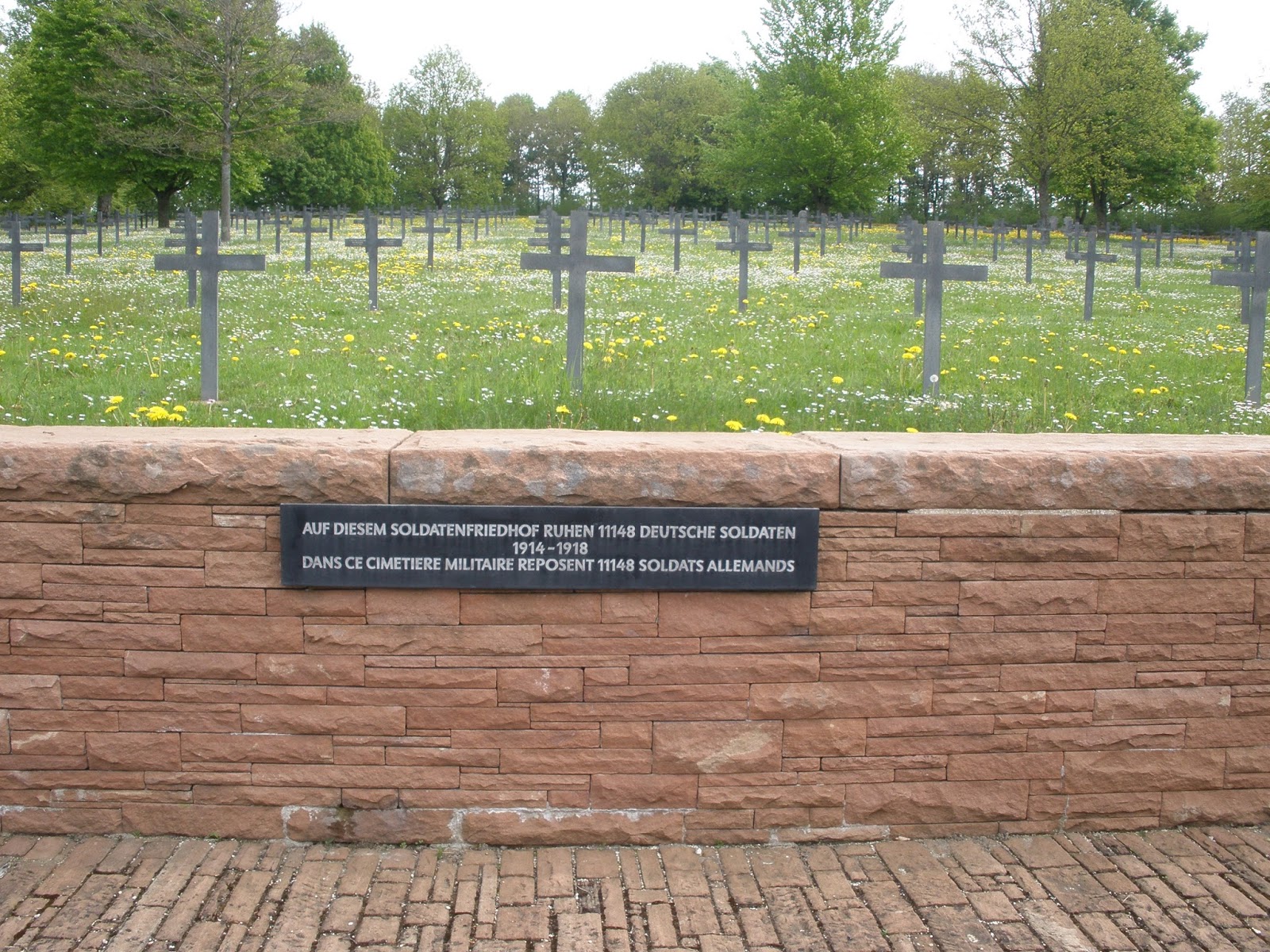
German Cemetery in Consenvoye, France in Argonne. Why are they here?

     Stark black crosses mark the graves of 11,148 German soldiers who died in the Battles for Meuse-Argonne in Autumn 1918 in France.

     Here near the American Cemetery of the Meuse-Argonne rest these soldiers along the highway outside the very tiny town of Consenvoye, France. As you can see here, the plots are not as well tended as the Americans'. We understand this decision.

     But when I talk about this quiet little cemetery along the road to our own huge one, many ask why these German soldiers are laid to rest here.

   One reason, we learn from memoirs of American soldiers, nurses and ambulance drivers, is that the Germans retreated very rapidly in the Argonne offensive. They left, rushing to their homeland, leaving behind huge amounts of armaments and supplies. One account noted that the Americans had to climb into trucks to pursue them, the Germans were running so quickly. They had no time to bury their dead.

     In fact, American burial teams did this for them. And while it is true that they buried their foes' bodies after interring their own deceased, nonetheless the Americans did do this.

     For more on this, please do read a stirring account of this in Brannon Simon's edited version of his grandfather's diary (one I highly recommend).  The buy link for his wonderful book, THAT's WAR, is: http://www.thatswar.com/index.php?option=com_content&view=article&id=179&Itemid=230.

"In this soldiers' cemetery rest 11,148 German soldiers."

 
I took this picture in late April when the dandelions are in bloom, a contrast to the serene black crosses.

Friday, November 1, 2013

Plastic Surgery began when thousands of WWI survivors needed to go on with their lives


Illustration of one man's facial wounds
Musee de la Grande Guerre,
Meaux, France
(My photo)
Prostheses for various types of wounds,
as seen in Musee de la Grande Guerre,
Meaux, France
(my photo)


Today, plastic surgery is so common that it is an elective procedure for many.
But in 1917, when America entered the Great War, plastic surgery was so new that even attempts at skin grafting were primary challenges for surgeons. As surgeons continued to improve their techniques, others assisted soldiers who needed a way to literally face the world and return to their normal lives.

IN American surgical front line units, nurses assisted in 3 main types of severe wounds: those wounds to the head, chest and abdomen were considered the most severe.  Soldiers with these types of wounds who might best survive surgery were "triaged" to be put at the front of the line for care. Yet of course many of the men who incurred these wounds suffered the most hideous disfigurations. These men, capable of living normal lives despite these facial wounds, were the ones that many medical professionals wished to save to live more appropriate daily lives.

Two such people who helped were not surgeons, but sculptors. In fact, one was a woman, Anna Coleman Ladd, an American who worked in Paris in her own studio and whose fame spread as her work helped hundreds of disfigured wounded. In her studio, mirrors were banned. By 1919, she had created more than 180 masks for disfigured soldiers. To read more about her, read this SMITHSONIAN MAGAZINE article: http://www.smithsonianmag.com/history-archaeology/mask.html#

Another sculptor was Derwent Wood, British, who had volunteered to work in hospital wards when he learned he was too old to volunteer to fight. Wood began a practice of molding thin metal to the shape of the soldier's face, then painting it to match skin color and attaching behind the head. He is known for working in the "Tin Noses Shop" or as it was officially termed, Masks for Facial Disfigurement Department, located in the Third London General Hospital,Wandsworth. For more than 20,000 British facially wounded in the war, Wood was able to help hundreds. Others depended on advances in surgical procedures to alter their appearances.

Englishman Derwent Wood putting finishing touches
to one soldier's partial face mask.
Anna Coleman Ladd, American sculptress, 1878-1939 

Examples of facial masks or prostheses developed to aid soldiers wounded facially in Great War. These are 
from the British, called the Tin Nose Shop.


Wednesday, October 30, 2013

American Nurses in WWI trained in Army camps and marched in parades!

   Women recruited for Army Nurse Corps and for American Red Cross all had field training by the American Expeditionary Forces. Army Nurse Corps recruits were all registered nurses, or the equivalent, having had two to three years professional nurses training. American Red Cross recruits, on average, had only a few months training (and as a result took on lesser responsibility in the wards). But all of them went through medical training specific to the care and treatment of those with wounds, or suffering from trench foot, trench fever, dysentery and Spanish flu.

   Army Nurse Corps recruits went to Army posts for training and many of them had French and British instructors. All were considered contract labor, without rank and yet were expected to act like regular Army recruits, "falling into line."

  They were housed in separate barracks, ate in mess halls separate from officers. When ready to ship out, they were housed in hotels near their embarkation points. A few of these were in Hoboken, New Jersey and others in Manhattan. Sometimes depending on the Navy's warnings of U-boat activities, nurses waited for more than 2 months in these hotels ready to leave at a moment's notice. And what could they take with them? One steamer truck (no larger than 36" wide), one small suitcase and a blanket roll!

   Many were also expected to march in parades. Here is a unit from Houston, Texas, marching together before they ship out!
Accession number1999.20
DescriptionBlack and white photograph of a Red Cross parade in Houston, TX.

From the service of Rose Baker (?), American Red Cross Nurse - Army Nurses Corps.
 
And here, in dress uniforms, a group of Army Nurse Corps recruits march in France!

A group outside their barracks.

Friday, August 16, 2013

18+Days in the AEF's footsteps: Day 8, Traveling through Champagne, East to the extended American front line and City of Verdun

 
Town Center of City of Verdun
This statue symbolizes the resistance
of the people of Verdun
to the German advances north of the town
in the Ring of Forts
     As the First Division arrived in France in 1917 and more Divisions came to fill in the ranks and enlarge the battalions, the American front line became more of a reality, less of a concept.
 
     Remember that the American sector, such as it was defined, was a creation of General Pershing who refused to combine the American forces with those of the French or British. Those allies wished for more men to fill out their ranks, decimated as they had been by three years of bitter trench warfare.
 
    With the arrival of more and more American soldiers and Marines, Pershing foresaw that he could build a fighting force as strong or stronger than his allies'. He wisely engaged French and British instructors in every type of training from flame-throwing to grenade use to efficient medical procedures. Furthermore, Pershing was an advocate of aggressive tactics and refused to fight the inch-by-inch warfare that had stymied the French and British efforts to get out of the trenches and pierce the German lines.
 
    Driving east from Chateau-Thierry through the Champagne is a peaceful agrarian scene. Bright yellow with mustard plants or grape vines along the rolling hills, the land is a lovely vision. Pictures of the landscape in 1917-1918 show a stark contrast. Awed as we were by the huge expanses of crops and large number of privately held farms, my husband and I had to research the level of farm production in France. Sure enough, it is huge, producing 20% of all food for Europe. Although this French percentage to the food basket of Europe is larger today than in the war years, we saw the potential that Germany must have gauged. Germany, before the war, had a prosperous economy with a growing population. Given the emphasis on industrial production, fertile French land must have been a lure to feed their hungry people.
Along the banks of the River Meuse stand these five French soldiers of
La Grande Guerre. Ever-mindful of the enormous efforts of the French military
to save the City manning The Citadel and in the Ring of Forts,
the citizens prize this sculpture which represents
each type of soldier who served in the war.
 
     We chose to make our base the City of Verdun as we explored the areas of the American eastern front lines. We were happy we did. Why? The City is one of the loveliest and best preserved even from that period. Assaulted as it was from most sides, the City represents to this day the stalwart nature of the French who retained the land at the cost of hundreds of thousands of French poilus, the near-starvation of the City's populace and the Americans who came to help them save it.


  On Sunday along the west bank of the quai, we ate our dinner. Prosperous, the citizens shop, eat, take their children and walk their dogs along the River. (Enlarge this pix to see the 5 French soldiers situated near the pole here, but along the eastern bank of the Meuse.)
   We stayed in a hotel along the banks of the Meuse, within walking distance of The Citadel. (Return for my next post when I take you there.) Verdun today is a serene city along the River Meuse. There on a weekend, we strolled along the quai and ate in a riverside cafe. We marveled that this city was once the prize fought over by millions of men on both sides of the conflict. But nestled as it is along the ridge of mountains near the Alsace and German border, we see the town's vulnerability. Controlling it meant access to the other rivers and major cities west, including Paris.

   We marveled too at the influence of Americans and Germans. How did we gauge it? Everything—signs, brochures, menus and more—are most often given in triplicate: French, German and English. (A treat for this gal whose German-American family taught her the German language!)

Friday, August 9, 2013

18+ Days in AEF's footsteps: DAY 7, Chateau Thierry and the Second Battle of the Marne

USA Monument to those who fought and fell at Chateau-Thierry
sits atop a hill overlooking the prosperous city.

(River Marne to the left of pix and this road which runs along the river.) 
Sculpture on the Chateau-Thierry Monument
France and USA, holding hands,
Partners in War and Peace

    Chateau Thierry is a lovely town along the Marne River approximately 50 miles east of Paris. In the spring of 1918, the Germans decided to attack their lines in France with great force and hopefully win the war before the Americans could arrive in massive numbers.
   A year had passed since America had declared war and finally, the country had enough recruits, transportation routes and sufficient supplies to convey a million men to Europe, feed, clothe and care for them.
   No small part of this was the need to provide medical care. While a few Base Hospitals (as the primary structure of medical personnel was called by the Army Medical Corps) had arrived in France in spring 1917, they assisted the French and British caring for those nationals.
   Now with the arrival of American men, other based hospital units arrived in huge numbers. Consisting of doctors, dentists, orderlies and pharmacists and nurses, these units could vary in numbers. (In fact, as the Spring Offensives of 1918 proceeded, the US Army called for more recruiting of doctors and nurses. The Army originally thought 50 nurses per Base would be sufficient but soon sought 100 per Base.) While Army Nurse Corps recruits assisted in the Operating Rooms and ran the wards, American Red Cross nurses who had much less training worked as their staff. Usually 50 to 100 nurses worked the Base Hospital wards and surgical units along with 50 or more doctors and dentists. Orderlies and pharmacists (or trained orderlies who did this work) were fewer in number and varied according to location, total force numbers in the area and notice of imminent attack of the enemy.
   Within one mile of the town was a major Base Hospital at Aulnois. Here, the nurses often sponsored dances for their patients. Men who played instruments practiced in the wards and became pick-up bands. These entertainments were welcomed by the staff and the soldiers breaking the tedium of their days and the journey back to health.
One of Operating Rooms, Mars Hospital Center, France*
Note cinder block structure in this OR
as opposed to wooden structures or tents used for Mobile Hospital Units.
Note, too, nurses in grey crepe uniforms with white butcher aprons used in ward duty.

*Mars was composite center far back of front lines and not in Chateau-Thierry sector but farther east near Toul.

Lab at Mars Hospital Center, France
Orderly Mixing Compounds

Memorial atop a hill overlooking the town.
Inscription: "This monument has been erected by the United States of America to commemorate the services of her troops and those of France who fought in this region during the World War. It stands as a lasting symbol of the friendship and cooperation between the French and American Armies."

   Traveling the area around Chateau-Thierry, I easily saw the importance of this town along the Marne. Hold it and any military force could easily attack or defend the river's access to the capital city of Paris.
Do see the picture at the top of this post once more. There on that hilltop, I capture its position which was a disputed territory taken eventually by the American First, Second and Third Divisions. See also views east and west along the Marne, now serene.
Along the River Marne, looking in the same direction
as American Monument


View of the Marne, flowing east, in this lovely city.


American troops crossing the Marne in Chateau-Thierry.
American troops in public square after capture
of Chateau-Thierry,  July 1918.
This square facing Hotel de Ville to the right of picture and Marne to the left is now a parking lot!
Ruins of Chateau-Thierry, in upper right you see Hotel de Ville, City Hall.
American troops clearing a road in Chateau-Thierry.

Aisne-Marne Salient Map on the American Monument high above Chateau-Theirry.


Sunday, July 7, 2013

18+ DAYS in AEF's Footsteps, DAY 6: Aisne-Marne Cemetary, Belleau Wood, France

U.S. Government photo, public domain
(disputed locale: either Belleau Wood or in the Argonne)
The battle of Belleau Wood, June 1-26, 1918 along the Marne River northeast of Paris was the battle that the US Marine Corps marks as one of its most honorable.

Pursuing Germans across an open wheat field toward a dense woodland heavily defended by the enemy, the Marines suffered as many casualties in these woods in a few days as they had previously lost in all former engagements since their founding in 1775. Here they encountered Germans heavily armed with machine guns and well entrenched in foxholes and dug-outs in the slippery muddy hillside. They also encountered gas attacks, escaping the woods only by forming a long line and placing one hand on the shoulder of the man in front so that they could march out of the battle zone.
Gas Attack Victims in line of evacuation; this is a British unit, 1918.

A nurse administers eye drops to gas attack victim.
Aerial view of chlorine gas attack, WWI.
1920 Picture of various types of gas masks used during WWI.


At left, we see one picture of that devastated forest as the Marines fire at the enemy.
Second Battle of Marne, Belleau Wood, Chateau-Thierry

The Marines fought so vigorously to gain and retain their hold of the woods that the Germans dubbed them Devil Dogs, or Teufel Hunden. To this day, the Marines honor the valor of the men who fought there by using it as their own nickname.
A US Marine Corps Recruiting Poster

The Aisne-Marne Cemetery, known to many as Belleau Wood Cemetery, lies five miles east of Chateau Thierry. The Battle of Belleau Wood and Chateau Thierry are part of the larger campaign, known as the Second Battle of the Marne.  Driving in this area, you can readily see the importance of maintaining control of the wide, easily navigable Marne River. Along the same parallel as the city of Meaux, where La Musee de la Grande Guerre is, these two battle sites are significant in that they were disputed territory between Germans and French for many years of the war until the American AEF forces took up positions along these lines and held them, then advanced them in the Spring Offensive of 1918.

In this cemetery, 15% of the men buried here are Marines who lost their lives in this Second Battle for the Marne. All others buried here are US Army and National Guard. No nurses are buried here.

Like other American cemeteries, the land is meticulously landscaped. Beneath pristine white marble crosses are the remains of 2,289 American servicemen. Another 1,060 men who are missing in action are commemorated in the chapel where their names are inscribed on the walls.

The cemetery is on the slope of a hill adjacent to Belleau Wood. Here in close-up you note the detail on the outside, including the sculpture of a nurse, 3rd from left.

   In graceful arcs, the graves mark the slope of the hill. On the half hour, the chimes in the chapel ring out. As in other American cemeteries, the songs played bring tears to your eyes. They include The Battle Hymn of the Republic, God Bless America, Saving Grace and The National Anthem.