See all my books!

Thursday, January 23, 2014

What to exclude in a historical novel? The draperies? Scarlett used them! A few illustrations of my choices!

Inside Church at Benzu-le-Guery, France
Field Hospital No. 1, 2nd Division, June 16, 1918
Note wounded on floor, nurses and doctors tending men
My husband, wise soul that he is, often says he wants to read the essence of the action in a novel. Please, he tells me, do not hang the draperies for me. Nor tell me their color. Tell me about them if they are useful to the plot.
Only Margaret Mitchell used draperies to best fictional purpose: She took them down, altered them and made them into a dress for vain Scarlett so that she might seduce Rhett Butler.
Well, that brings me to the novelists' dilemma: What precisely are the drapes and how do I know?

Here are a few rules of selection from one who has written many hundreds of thousands of words, fiction and non. Yes, non-fiction requires a bit of discretion, too, when writing.

1. Does the fact fit best in this spot, that one...or not at all?

Illustration: I had a few facts about devastation of the French countryside circa 1917-1918 from many primary sources. Where and how to use them?
Why?
I did sprinkle them in at various points to show the journey Gwen Spencer was taking from her peaceful life in Pennsylvania, USA, to the war-torn countryside of north eastern France.

I use the scarcity of population to shade in desertion of the land far back of the line.

Many pages later, I use the ruins of a village to show how war destroyed homes and entire towns.

Much later, as Gwen disembarks on a train at Gare d'lest in Paris, I have her see how hundreds crowd into the cars, their arms full carrying their clothes, a dog or a chicken, their eyes glossy with despair as they flee bombs and advancing armies.

2. Does the particular detail add any color or drama that I don't already have? Or is its addition overload?

Illustration: I have a few sources that describe how British destroyers came out at Portsmouth to accompany US warships on route to St. Nazaire and/or Bordeaux.

Man being carried into Dressing Station in French hillside
April 26, 1918
I showed how intimidating it was to someone like Gwen who had never seen a warship so huge and I had already painted in a tragic event on that warship.  My conclusion was that if I added this fact of British destroyers, I would minimize the "lesson" learned at the end of that tragic chapter.

I decided to forgo the British convoy and instead open the next chapter on the docks in St. Nazaire. Here, Gwen sees an unusual sight that is more intriguing and raises more questions for her to answer than to have put her out to sea, literally, with the British escorts.

3. In a women's historical, just how realistic should I be when describing wounds, surgery and death?

This is the BIG Question which I see so many authors (romance, mystery, fantasy—yes, fantasy!) dealing with as they use war as backdrop to their fiction.

Illustration: In my research, I read numerous first hand accounts by nurses who hated the smell of unwashed bodies, urine and feces. One nurse unwraps a man's bandages and his brains fall out. She is horrified and shoves them back in, not knowing what to do, realizing years later, that he must have been dead already. Another recounts the men who crawled in to her tent, clutching their own entrails in their hands. These things happened. They are a part of any war. They were a part of this war.

Trust me, to have included all of that in raw detail would have raised a ruckus among women readers (my main target audience), even among many who read historical fiction and praise accuracy. I have one review already from a woman who has roundly criticized me for

Triage station, 42nd Division, Suippes, France, July 17, 1918

how "gory" my descriptions are. THAT surprises me. But many will pick up a book, expecting one thing and becoming angry at the author who does not provide precisely that. I personally thought I went out of my way to make the book as useful to set the scene as possible. I knew I was not writing an apologia, and I was definitely not writing a blood and guts battle guide for those, especially men who like to read stories of battles.

An author's choices are myriad. The ones that become a part of a novel are the most useful "translations" of fact to the devices of the plot and nuances of character growth.
Dressing station, motorized ambulance, Ambulance Company No. 137,
Alsace, August 31, 1918

Monday, January 6, 2014

PUBLISHER'S WEEKLY, Beyond Her Blog reviews HM "…depict[s] characters, setting and plot vividly...I was enthralled."


Beyond Her Book


Heroic Measures by Jo-Ann Power
heroicmeasures
Read by Sue
Hardened by her life with her embittered, greedy aunt, newly-qualified nurse Gwen Spencer is determined to devote her skills to the wounded soldiers of World War I. Convinced she has the “guts, nerves of steel, and tremendous heart” necessary, she is still unprepared for the horrors of the military hospitals and front-line aid stations. Her only relief from those horrors is a best friend from home, and the romantic attentions of Richard, a British nobleman whose family has been deeply damaged by the results of the conflict.
Jo-Ann Power has succeeded in depicting her chosen characters, setting, and plot vividly, and I was completely enthralled. I was particularly moved by the way she conveys the various ways this “war to end all wars” ravages all it touches. Gwen and Richard earn their happy ending, but a number of ongoing plot threads set the stage for the second book in the trilogy.
***********

Wednesday, December 18, 2013

Joint Forces Journal calls HEROIC MEASURES "a riveting and historically accurate novel!"

Joint Forces Journal, a privately published newsletter for members of the United States Armed Forces of the United States Army, Navy, Marine Corps, Air Force and Coast Guard praises HEROIC MEASURES as "…a riveting and historically accurate novel."

This review appeared in their latest issue, and you may view it in its original form at this url link: http://www.jointforcesjournal.com/_jfj.php?READ=yes&which=1048

But you may also view it here as I attempt to take screen shots and piece them together for you!

I am delighted with the honor of their review and extremely delighted to have their praise.


Wednesday, November 20, 2013

Lafayette Escadrille, Lex Learner in HEROIC MEASURES flies for Army Aero Squadron & beginning of American Air Force

   
Flag with logo
   The volunteers who went to France before the USA declared war in April 1917 were men who had enjoyed the luxury of learning how to fly aeroplanes. Most of these men were college students from well-to-do families. After all, flight instruction was expensive!
   
    Because the United States had declared itself a neutral country, any Americans volunteering had to belong to a "neutral" unit. Hence, they joined the "unofficial" flying unit of the French aero fleet. The French were canny and called it after the famous French aristocrat who had been a leader in the American forces aiding George Washington in the Revolutionary War.

     Aeroplanes were relatively new transportation, produced in greater numbers only at the beginning of the 1910 decade. Planes were fragile, constructed of plywood, a few bits of metal and the gas tank. Those who flew understood that they had to be very cognizant of wind, shear, temperatures and storms. They also knew that once off the ground, flying a mile or two in the air was extremely cold. All those photos we see of men in leather jackets with huge scarves around their necks is no fabrication! They were frozen up there—and suffered colds, pneumonia and massive ear infections as a result. (So does Lex Learner in HEROIC MEASURES!)

     Accidents, too, were very common. Only as manufacturers took advice from experienced pilots did they begin to produce planes that were sturdier and offered more functionality. The Germans produced quite a few models before and during the war, including the Fokker and Junker, both useful in bombing raids. The French produced a few, too, the most famous being the Nieuport, used by our Escadrille and by the men in that unit who transferred to the new US Aero Squardrons when we declared war.

     In wartime, the probability of accidents increased. And as the men of the Escadrille learned from their French cohorts how to fly amid cannon fire, they also learned how to take reconnaissance pictures
and drop bombs. As the war wended on, they also learned how to use the newest of the deadly technology—the machine gun.
Nieuport's were choice of US Aero Squardrons,
light and efficient.

     Life expectancy was short. In fact, most of the men who originally served in the Escadrille died in service. ONe of the few to survive, and one of the most famous, is Eddie Rickenbacker. He went on to found a major airline in the United States. ____
Air Service Map, A.E.F. aerodromes:
The most active squadrons—for bombing raids and surveillance—were stationed
in the northeast sector, near Chaumont, US Headquarters, and employed heavily
in the battles for St. Mihiel and in the Meuse-Argonne drives,
September 1918 through November, 1918.

Sunday, November 17, 2013

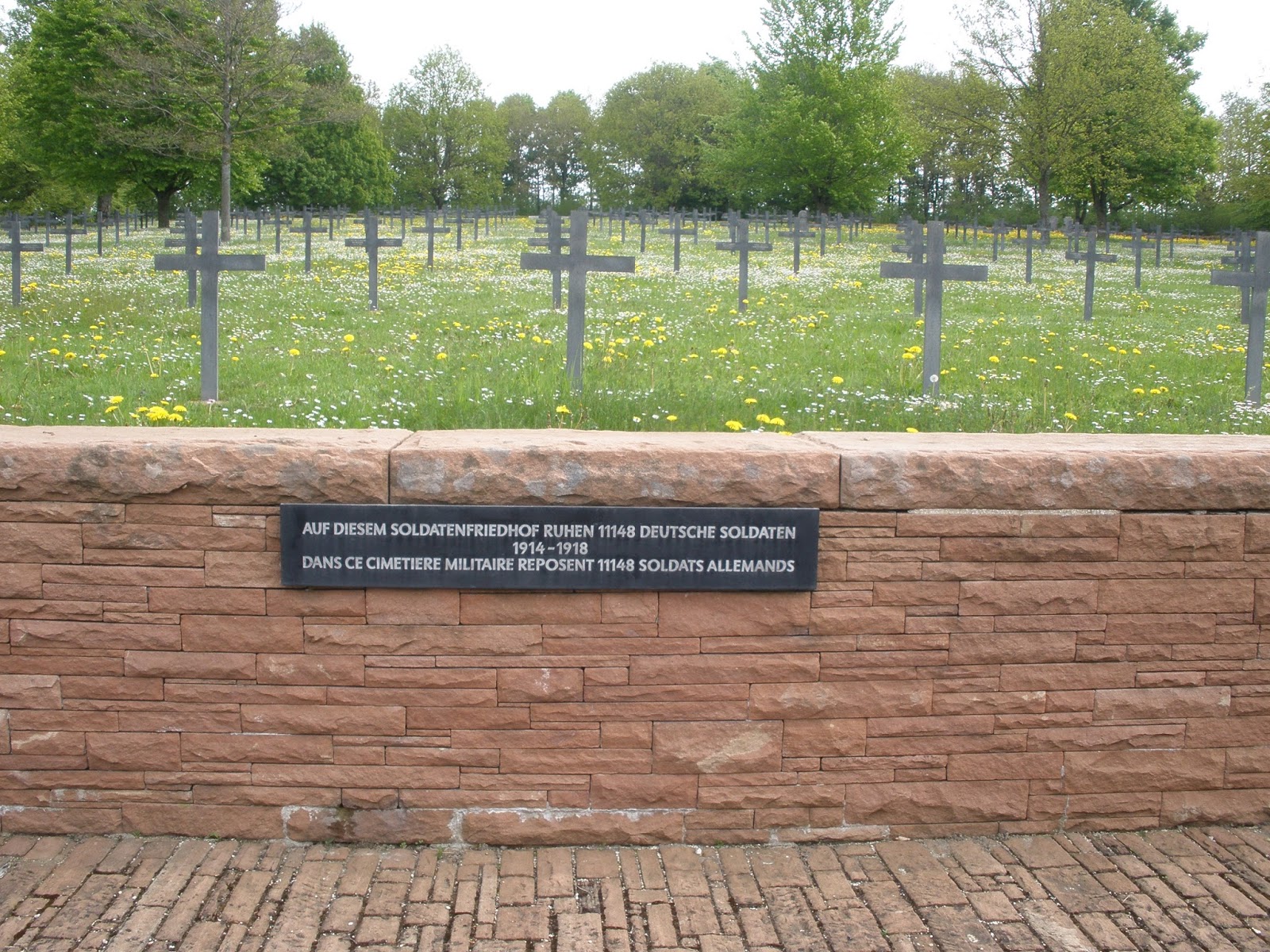
German Cemetery in Consenvoye, France in Argonne. Why are they here?

     Stark black crosses mark the graves of 11,148 German soldiers who died in the Battles for Meuse-Argonne in Autumn 1918 in France.

     Here near the American Cemetery of the Meuse-Argonne rest these soldiers along the highway outside the very tiny town of Consenvoye, France. As you can see here, the plots are not as well tended as the Americans'. We understand this decision.

     But when I talk about this quiet little cemetery along the road to our own huge one, many ask why these German soldiers are laid to rest here.

   One reason, we learn from memoirs of American soldiers, nurses and ambulance drivers, is that the Germans retreated very rapidly in the Argonne offensive. They left, rushing to their homeland, leaving behind huge amounts of armaments and supplies. One account noted that the Americans had to climb into trucks to pursue them, the Germans were running so quickly. They had no time to bury their dead.

     In fact, American burial teams did this for them. And while it is true that they buried their foes' bodies after interring their own deceased, nonetheless the Americans did do this.

     For more on this, please do read a stirring account of this in Brannon Simon's edited version of his grandfather's diary (one I highly recommend).  The buy link for his wonderful book, THAT's WAR, is: http://www.thatswar.com/index.php?option=com_content&view=article&id=179&Itemid=230.

"In this soldiers' cemetery rest 11,148 German soldiers."

 
I took this picture in late April when the dandelions are in bloom, a contrast to the serene black crosses.

Wednesday, November 13, 2013

Mobile hospitals, Surgical teams, X-ray trucks, Sterilizers and more!

US Ambulance, circa WWI, holds 4 men!
How do you best save wounded men if:

1. they are sometimes carried by 4-6 stretcher bearers for 1 mile or more before getting to ambulance

2. they must travel over muddy, shell-warped lanes for 3 to 5 miles back of line to get to a sterilized operating room

3. only at night, lest the enemy see the ambulance line during the daylight and bomb them

4. in ambulances that hold either four or eight

5. with only barest field dressings on utterly horrific head, chest and intestinal areas

6. with limited morphine pills

7. not enough front line surgeons

8. who have limited facilities (surgical supplies, no needles, no ether, no nurses, orderlies only...)

The United States Army Medical Corps answered these challenges by creating mobile hospital units. These teams of expert surgeons, nurses and orderlies formed 7-member teams who volunteered to go directly in back of the front lines of Doughboys.

US Army Mobile X-Ray truck, WWI
These men and women were screened to be the most professional, stable, healthy individuals who had proven their resilience and talents in the first months that Americans had gone abroad. Then, as the need for medical teams to be much closer to the wounded became vital, mobile surgical units were created.

Composed of one surgeon, one assistant, two nurses, one nurse anesthetist and two orderlies, this team would receive a wounded man and immediately operate on him.

To ensure that this occurred within minutes, the mobile unit also consisted of admitting officers who were trained in triage, x-ray technicians and ambulance drivers who took the post-op patients and transported them farther down the line to another mobile unit or a larger facility, also mobile, called an evacuation hospital.

Want to read about one in action in the Meuse-Argonne in November 1918 during the Big Push?
Read HEROIC MEASURES, out now.
In there, you see how the main character, Gwen Spencer from Scranton Pennsylvania joins a mobile surgical unit and survives the rigorous PUSH in The Great War.

A group of trucks in a mobile unit would pull into a clearing and go to work!
This was their configuration.

Even men of the ambulance units had to pause to line up and get a bath! Note that water had
"to be carried several blocks an coal is scarce. Rambillard, France, Oct. 23, 1918


Sunday, November 10, 2013

TOMORROW, 99th Anniversary of Armistice! Honor the women and men who fought in The Great War and read HEROIC MEASURES

     When the British, French, Americans and Germans and Austrian-Hungarians signed the Armistice agreement November 11, 1918 in Compiegne, France, the world celebrated a cease fire, the end of the slaughter that typied the war.
     Here is the famous picture of those who signed the agreement in the railroad car along the front in northern France.
Photographer unknown. In public domain in EU, UK and USA.
     Millions in tiny villages and large cities across the world came out to mark the end of this tragic conflict. Some danced. Most cried. Millions mourned their loss of  friends and family. For thousands who served, many decried the impairment of their health. Bitter and devastated, the millions who survived had before them an extremely difficult time recovering. Whole towns had disappeared. Home and farms were destroyed. Landscapes were forever altered by huge bombs, tunnels and gas warfare.
    People had to deal with the loss of millions of their loved ones. In Britain, so many young men had been killed that the Government soon developed a program for unmarried women to move abroad so that they might find husbands in the Commonwealth countries. Wounded, largely due to the improvement in medical care, survived by the hundreds of thousands. As amputees, many learned to use prostheses. Others who were facially wounded underwent new skin grafting techniques that were to be the solid basis for the development of plastic surgery.
     Today, the park and forest around Compiegne's treaty site are peaceful sites. Like that day when the Entente military leaders and their German counterparts met in a railroad car, the foliage is thick. And as then, it is so deep you cannot see the sky. On that day, the Entente leaders wanted aerial coverage as protection but the canopy was so dense this was impossible.
Museum at site of Armistice signing.
Inside is Railroad Car, next in sequence of actual car since destroyed in fire.

Aside from this car, the museum houses wonderful panoramic pictures of all aspects of military life.
I estimate ninety percent of these are not duplicated anywhere else.

Outside in the clearing, this statue
to French General Foch
who received the German agreement to the cease fire for 11.11.18.
Memorial to the Heroic Soldiers of France
Defenders of the their country
and the glorious liberators of Alsace and Lorraine.
This stands directly opposite the building in above picture
which houses the replica of the train car where Germans agreed to cease fire.

Friday, November 8, 2013

Countdown to 11.11.13: What is your definition of heroism? How heroic are you?

 
Poster, public domain, USA
    What is your definition of heroism?
   Are women as heroic as men?
   Are you heroic?
   Who is your hero and what have they done to win this place in your heart and mind?
   These are valid questions each of us should ask ourselves as we prepare to commemorate on Veterans Day those who gave their all for us in war.
   These are men and women, not only in the armed services in all countries, but also in support services.
   In The Great War, we see the growth of the Salvation Army, the YMCA, more than one thousand different volunteer groups who gave of their time and services. The Salvation Army girls made Doughnuts. Yes, many say that the term DOUGHBOY came from the famous fried dough these women made for men to enjoy back of the line!
What did the YMCA do? Both men and women volunteers in that organization operated canteens for soldiers to buy hot chocolate, candy or cigarettes.
   Among the women who joined the Army Nurse Corps, we see women who worked 24 hour shifts as the fighting intensified, women who worked in wards where men dealt with discovering they were amputees or otherwise physically impaired. These women found a way to aid these men who realized that when they went home, they would be challenged by their new physical conditions. Some were paralyzed. Some were visually impaired. Others bore facial wounds. Others had wounds to the mind that we then termed "shell shock" and today we call PTSD.
   Many of these women died in the line of duty. Although not permitted to the front lines, women did suffer from malnutrition, pneumonia, ear infections, influenza and infections. Quite a few are buried in our American Cemeteries in France alongside our soldiers. Do ask the attendants when you visit to give  you the platts so that you can visit and pay homage to them.
USA Public domain, Poster.
And for those who cannot speak for themselves, then or now, I will show you a few pictures of the brave animals taken into service during the war. Note their varied roles.
Canaries who sang to wounded in hospital trains.

French Blue Cross Hospital for sick and wounded horses.

Here, to end on a note of joy, is a picture of Sergeant Stubby. Stubby served throughout the war, even capturing an enemy and holding him by the seat of his pants until relieved of his duty by a human! Stubby won many medals. A true hero for all of us to applaud!
Bull terrier Sergeant Stubby in his dress uniform with decorations!


Sunday, November 3, 2013

Video: History of US Army Nursing Corps, intro with footage of WWI Nurses

With marvelous footage and narration by former Army Nurse Corps Historian, this video is a comprehensive introduction to learning about American women who have served throughout US history to wounded and dying men in arms.
Significant here are notes that a nurse in 1917 volunteered for the duration of the conflict, she received pay half of officers and she held no rank. Indeed, she was addressed by her last name, a practice in civilian hospitals, or by the term, "Nurse!"
Hope all of you are reading HEROIC MEASURES to learn more about these courageous women who served in a foreign land under horrific conditions to save their fellow countrymen.